Dialer Ratios Explained: 1:1 vs 2:1 vs 6:1 and What They Mean for TCPA Risk
A dialer ratio is the number of phone lines an outbound dialer calls simultaneously for every available agent. A 1:1 ratio calls one number per agent and carries minimal TCPA risk. A 2:1 to 6:1 ratio calls multiple numbers per agent to increase live connects — but every line above 1:1 creates the possibility of a call being answered with no agent available, which is the legal definition of an abandoned call under the Telephone Consumer Protection Act. The higher the ratio, the higher the abandonment risk, and the more compliance controls a team needs in place.
This guide breaks down exactly how each ratio works, how abandonment risk scales with it, and how to pick a ratio that maximizes connects without crossing into legal exposure. For the broader mechanics of dialing technology, see this complete guide to outbound dialer software.
What Is a Dialer Ratio?
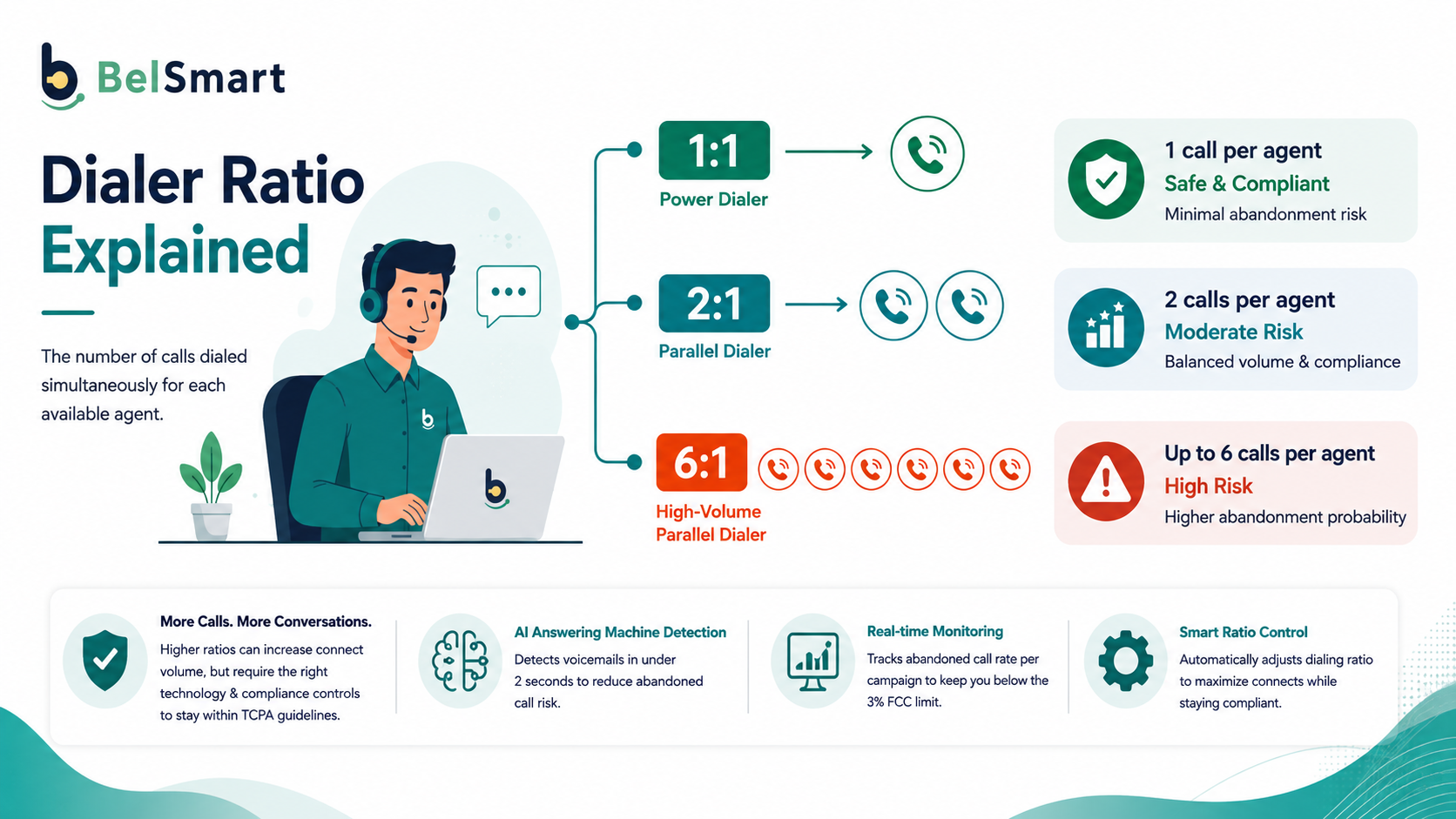
A dialer ratio (also called a calls-to-agent ratio or dialing ratio) describes how many outbound calls a dialing system places for each agent who is logged in and available to take a call.
- 1:1 — one call is dialed per available agent
- 2:1 — two calls are dialed simultaneously per available agent
- 6:1 — six calls are dialed simultaneously per available agent
The ratio is a core setting inside outbound dialer software, and it’s the single biggest lever that determines both how many live conversations a sales team has per hour and how much abandoned-call exposure a campaign carries under federal telemarketing law.
Dialer ratio is different from dialing mode (manual, preview, power, or parallel), though the two are closely related — mode determines how a call is initiated, ratio determines how many lines are open at once when it is.
Why Is Dialer Ratio a TCPA Compliance Issue?
Under the TCPA and the FCC’s implementing rules, an abandoned call occurs when a live person answers an outbound call and is not connected to a live agent within two seconds of a greeting. Abandoned calls are the direct byproduct of dialing more lines than you have agents to answer them.
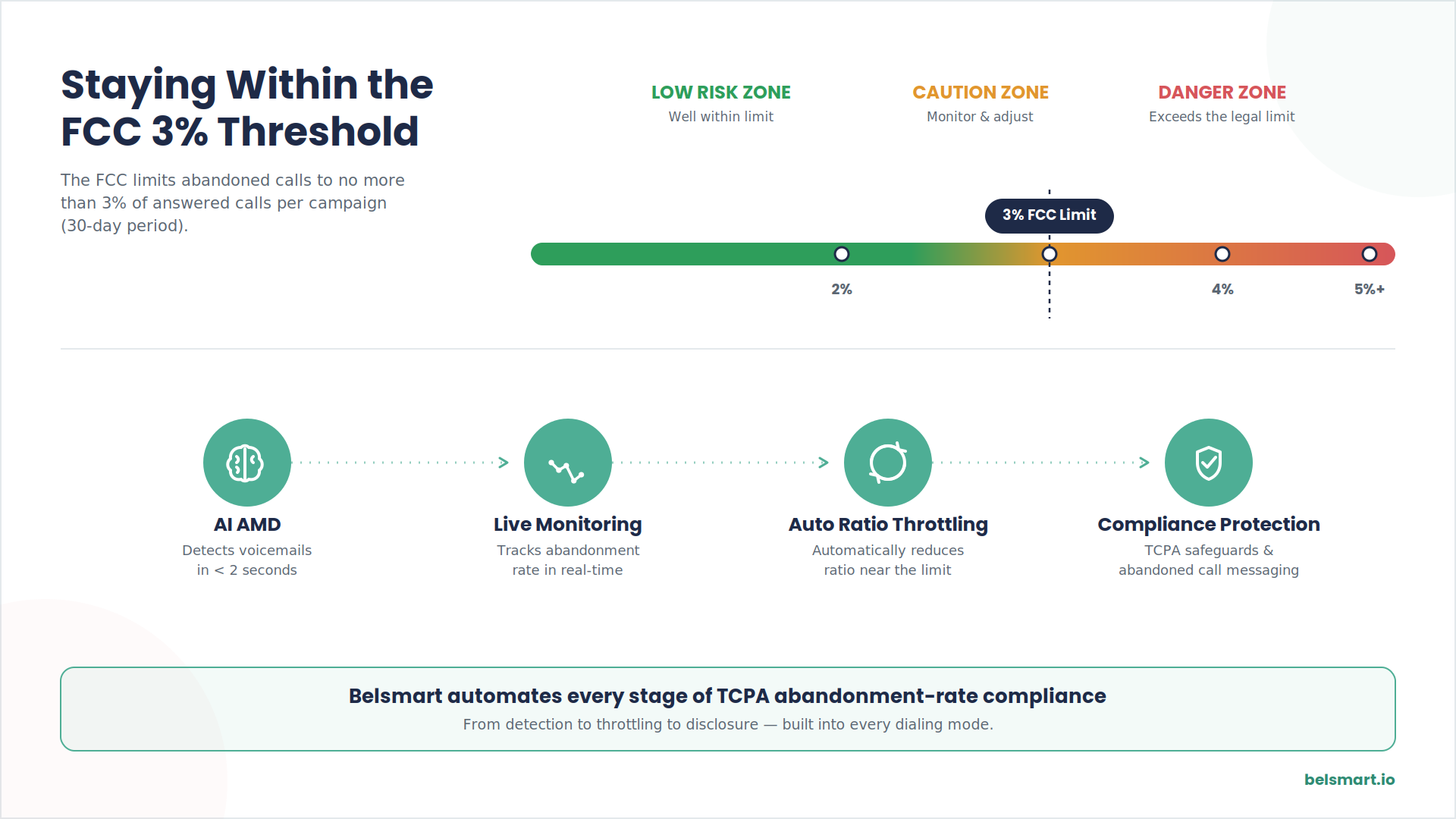
Key rule: The FCC’s abandoned call rate rule requires that no more than 3% of answered calls in a 30-day campaign period be abandoned. This ceiling applies per campaign, per calling list — not as an average across an entire call center. A single aggressive ratio setting on one list can push an otherwise-compliant operation over the legal limit.
For a full compliance framework beyond ratio — consent capture, DNC list scrubbing, and call recording disclosures — see our outbound compliance page.
The Three Ratios, Side by Side
Minimal Risk
1:1 Ratio — Power Dialing
One call is placed per available agent. As soon as an agent finishes a call, the system dials the next number for that agent only. There is never more than one line in flight per agent, so there’s no scenario where a call connects with no agent free. Best for B2B sales, insurance, and financial services outreach where compliance and call quality outweigh raw volume.
Moderate Risk
2:1 Ratio — Entry-Level Parallel Dialing
Two calls are placed simultaneously per agent; whichever connects first to a live person is routed through. Abandonment risk is low to moderate and generally stays within the 3% legal threshold when paired with accurate AI answering machine detection and clean list hygiene. Useful for mid-volume lead generation and warm or opted-in lists.
Highest Risk
6:1 Ratio — High-Volume Parallel Dialing
Up to six calls are placed simultaneously per agent, connecting only to the first live answer. With six lines dialing per agent, the odds that more than one connects to a live person at once rise sharply — every “extra” connection beyond the first is an abandoned call if not routed within two seconds. Common in BPO call centers and large-list campaigns via a parallel dialer, but it requires real-time abandonment tracking and automatic ratio throttling.
Comparison Table: Ratio, Risk, and Best Fit
| Ratio | Calls / Agent | Abandonment Risk | Typical Mode | Best Fit |
|---|---|---|---|---|
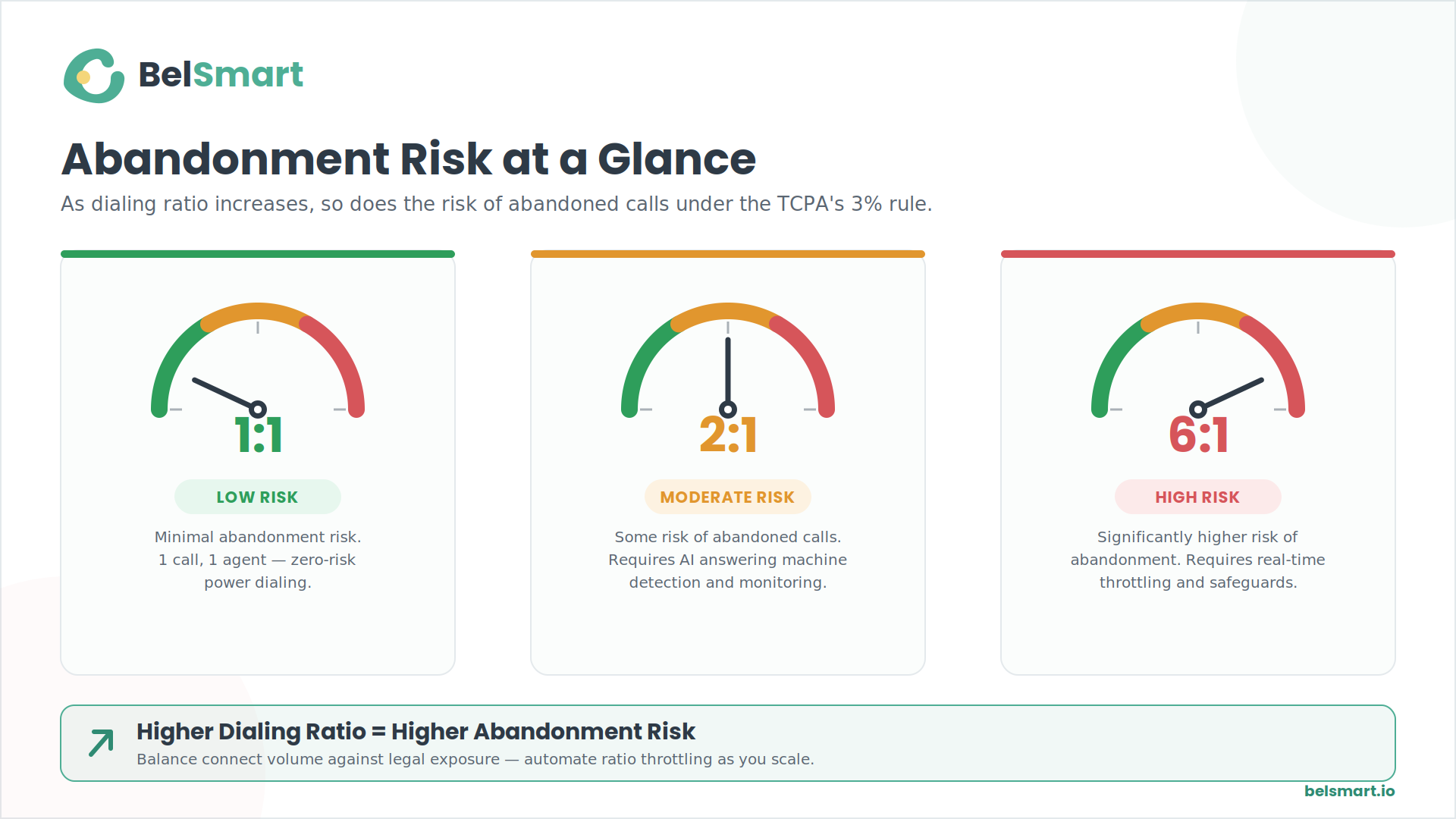
| 1:1 | 1 | Minimal | Power Dialer | B2B sales, insurance, compliance-sensitive outreach |
| 2:1 | 2 | Low–Moderate | Entry Parallel Dialer | Mid-volume lead gen, warm/opted-in lists |
| 6:1 | Up to 6 | High | High-Volume Parallel Dialer | BPO, political campaigns, large-list outreach |
The pattern is linear and predictable: every additional line per agent increases both connect volume and abandonment probability at the same time. The only variable a compliance team controls is how well the supporting technology absorbs that added risk.
How the 3% Abandoned Call Rate Rule Interacts With Ratio
The FCC’s rule doesn’t cap the ratio itself — it caps the outcome. A business can run a 6:1 ratio and stay compliant if it has the right safeguards in place:
- AI answering machine detection filters out voicemails in under two seconds, reducing false “answers” counted against the rate.
- Real-time monitoring tracks the rolling abandonment percentage per list, per 30-day period.
- Dynamic ratio throttling automatically lowers the ratio as abandonment approaches 3%.
- Compliant abandoned-call messaging plays automatically when a call is abandoned, per FCC requirements.
Bottom line: a high ratio without automated safeguards isn’t an aggressive growth strategy — it’s unmanaged legal liability. A low ratio with strong safeguards leaves connect volume on the table. The right approach matches ratio to list quality and compliance strength, not simply the highest number available.
Choosing the Right Ratio for Your Campaign
- Choose 1:1 for personalized, compliance-heavy conversations or regulated verticals like insurance and financial services.
- Choose 2:1 for warm or partially opted-in lists where you want a moderate volume increase without a heavy compliance burden.
- Choose 6:1 only with high-volume, well-scrubbed lists, real-time abandonment monitoring, and AI AMD already in place.
- Confirm ratio throttling exists before scaling any campaign past 2:1 — manual monitoring alone rarely reacts fast enough.
Belsmart’s dialer architecture lets teams switch between Manual, Preview, Power, and Parallel modes — and their underlying ratios — on the same account, per campaign, without re-onboarding. Every mode includes built-in TCPA controls: abandoned call rate limits, DNC scrubbing, consent logging, and AI AMD that detects voicemail in under two seconds.
Frequently Asked Questions
What is a good dialer ratio for TCPA compliance?
There is no universally “safe” ratio — 1:1 carries the lowest risk by design, while 2:1 and above require active abandonment-rate monitoring to stay under the FCC’s 3% threshold. The right ratio depends on list quality, agent availability, and the strength of your compliance tooling.
Can a 6:1 dialer ratio be TCPA compliant?
Yes, but only with strong safeguards: real-time abandoned call rate tracking, AI answering machine detection, dynamic ratio throttling, and compliant abandoned-call messaging. Without these, a 6:1 ratio has a high likelihood of exceeding the legal 3% limit.
What’s the difference between a power dialer ratio and a parallel dialer ratio?
A power dialer runs a fixed 1:1 ratio, prioritizing compliance and call quality. A parallel dialer runs a 2:1 to 6:1 ratio, dialing multiple numbers simultaneously per agent to maximize connect volume — increasing abandonment risk proportionally.
Does a higher dialer ratio always mean more sales?
Not necessarily. A higher ratio increases connect volume, but uncontrolled abandonment can damage caller ID reputation, trigger spam-likely flags, and create legal exposure that costs more than the extra connects are worth.
Choosing between 1:1, 2:1, and 6:1 shouldn’t be a guessing game.
Book a Personalised Demo See Plans & Pricing