AI AMD Accuracy: How Belsmart Detects Voicemail in Under 2 Seconds
Answering machine detection (AMD) accuracy depends almost entirely on which detection method is running underneath it. Legacy rule-based AMD is generally documented in the low-to-mid 80% range under real-world conditions, while machine-learning classifiers typically achieve accuracy in the mid-to-high 90% range. Modern AI-powered AMD typically reaches 95–99% accuracy, while legacy rule-based systems often top out around 60–75% in real-world conditions. Belsmart’s AI AMD is built on this newer classification approach — analyzing greeting cadence and speech patterns rather than waiting on fixed silence timers — which is what allows a routing decision inside a two-second window instead of the four-to-five-second delay older systems require.
This guide breaks down exactly how that classification happens, why speed and accuracy are in tension with each other, and what the tradeoffs look like in practice. For the full framework connecting AMD to dialer performance and compliance, see our complete guide to AI answering machine detection.
What “AMD Accuracy” Actually Means
Answering machine detection accuracy isn’t one number — it’s a set of tradeoffs between four possible outcomes on every answered call:
- True positive — a voicemail is correctly identified as a machine
- True negative — a live person is correctly identified as human
- False positive — a live human is incorrectly classified as a machine (the call gets dropped or routed to voicemail drop, and a real prospect never reaches an agent)
- False negative — a voicemail is incorrectly classified as human (an agent gets connected to a recording and wastes talk time)
Every AMD vendor’s headline “accuracy” number is really describing how well their system minimizes both error types simultaneously — and that’s a much harder problem than it sounds, because the two error types trade off against each other. A system tuned to avoid false positives tends to let more voicemails through as “human.” A system tuned to catch every voicemail tends to misclassify more real people as machines.
Rule-Based AMD vs. AI AMD: Why the Old Method Runs Out of Room
Legacy AMD, still widely deployed across the industry, works by measuring fixed thresholds: total greeting length, continuous voice duration, and silence gaps against hardcoded timers. If a single continuous voice segment exceeds a maximum word length, or cumulative voice duration exceeds a greeting threshold, the call gets classified as a machine. If none of these fixed conditions trigger within the analysis window (typically 5000ms), the result comes back “not sure.”
Key limitation: Fixed thresholds can’t adapt to how much voicemail greetings have changed. iOS call screening, carrier-level STIR/SHAKEN filtering, and modern voicemail systems have all shifted the audio patterns that older AMD was originally calibrated against — which is why a rule-based approach that scored well in 2015 can quietly degrade year over year without a single line of code changing.
How AI AMD Reaches a Decision in Under Two Seconds
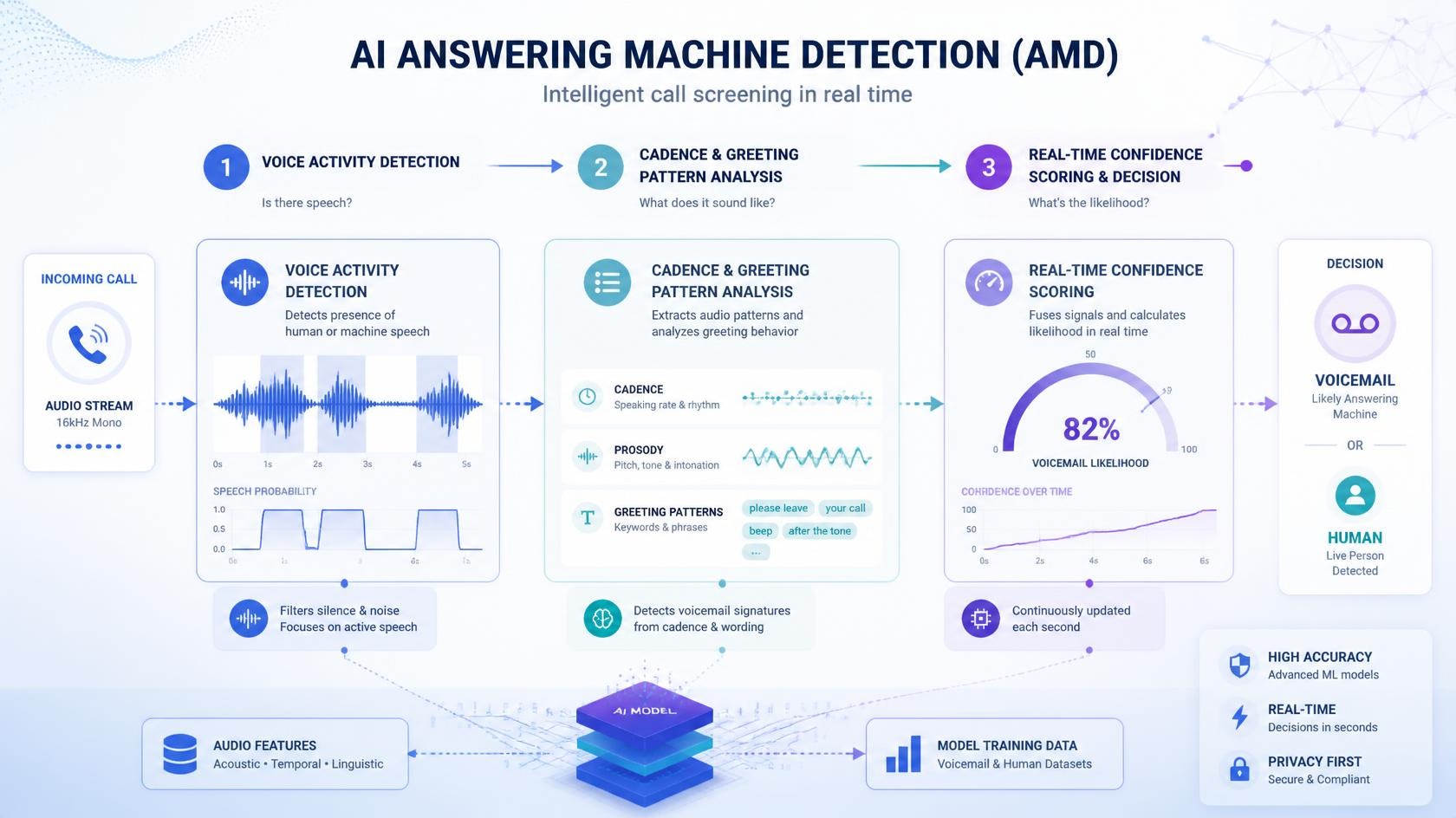
AI-based AMD replaces fixed timers with a real-time classification model that scores the incoming audio against learned speech patterns rather than a static rulebook. The core of this technology relies on Voice Activity Detection (VAD) to analyze the initial audio stream, and contemporary solutions use cadence-based logic to evaluate the rhythm of the greeting rather than simply waiting for a beep.
In practical terms, the classification pipeline is doing three things almost simultaneously the instant a call is answered:
- Voice activity detection — identifying where speech starts and where the first silence gap occurs
- Cadence and pattern analysis — comparing the shape of the greeting (short burst followed by silence, versus a long uninterrupted greeting) against trained patterns
- Continuous confidence scoring — updating the human-vs-machine probability in real time as more audio arrives, rather than waiting for one fixed checkpoint
Modern AI dialers increasingly layer natural language processing on top of this to identify specific speech patterns — the difference between a quick “Hello?” and a long, formal business greeting — which allows a more fluid, organic detection process instead of a rigid pass/fail timer check.
Why Speed and Accuracy Are Directly Linked to Compliance
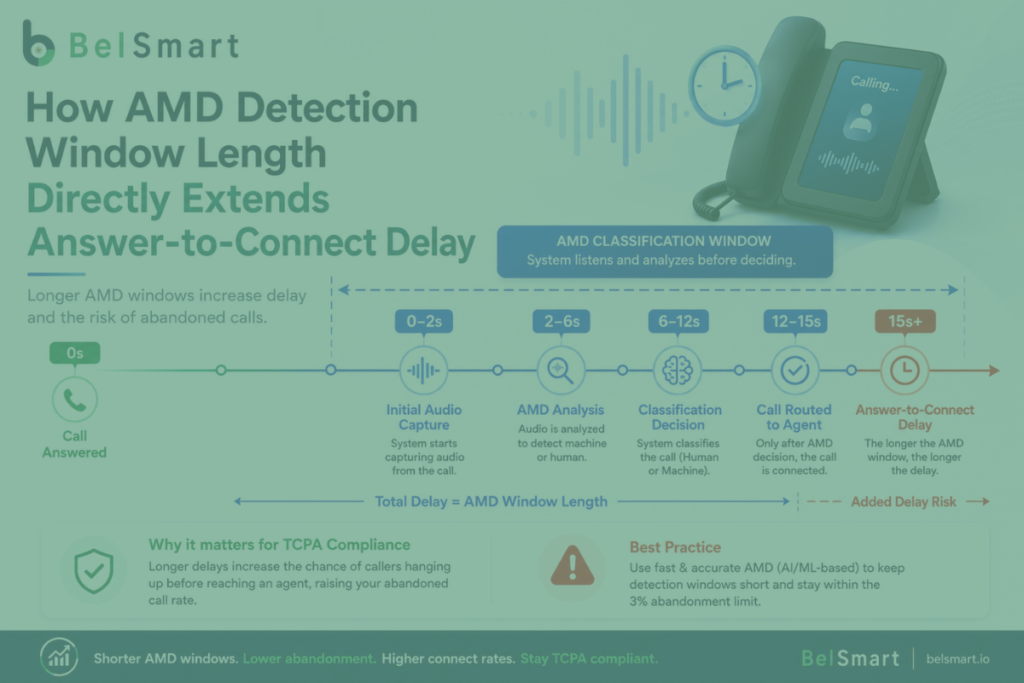
This isn’t just a productivity feature — AMD latency has a direct, measurable effect on TCPA abandonment-rate exposure. A call only counts as “connected” once it’s routed past AMD to an agent, so a longer AMD detection window adds directly to the answer-to-connect delay that the FCC’s 3% abandonment cap is measuring. A dialer that paces ahead assuming an instant connection, without accounting for AMD’s actual classification window, will systematically over-pace and can breach abandonment limits even when every individual call is legitimate.
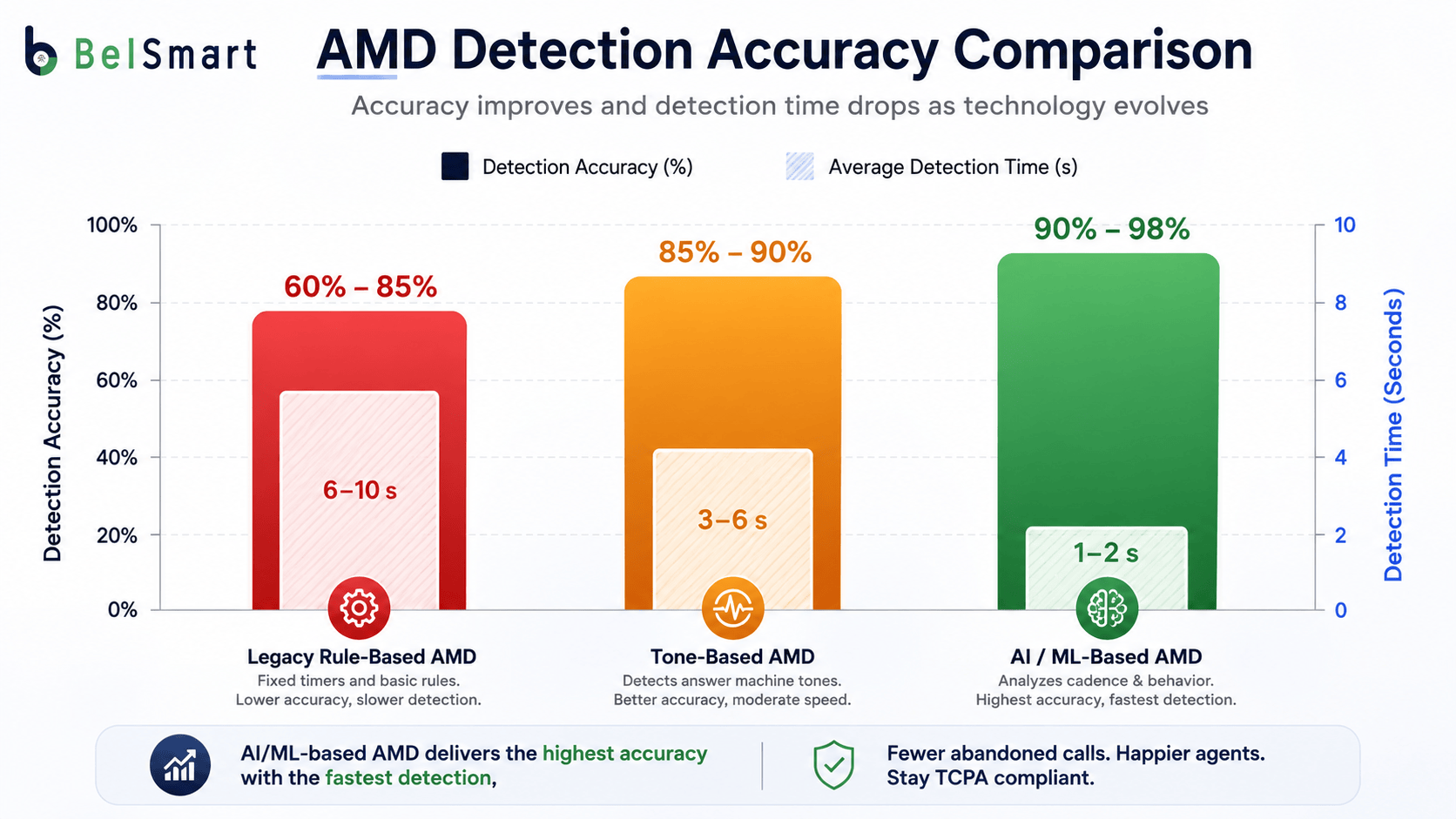
What Accuracy Numbers Actually Look Like Across the Industry
| Detection Method | Typical Accuracy | Detection Window |
|---|---|---|
| Legacy rule-based (fixed timers) | 60–85% | 4–5 seconds |
| Tone-based AMD | 85–90% | 3–5 seconds |
| ML/AI-based cadence analysis | 93–99% | Under 2 seconds |
Some AI AMD implementations report false positive rates cut by more than 50% compared to traditional AMD, which matters more than the headline accuracy number in practice — a false positive means a real prospect got misrouted, which is a lost opportunity, not just a statistic. For high-volume outbound operations where 40–60% of answered calls are voicemails, even small accuracy gains compound into a large amount of recovered agent time across a full shift.
What Happens on the Backend: Architecture Matters as Much as the Model
An AMD model is only as good as the infrastructure feeding it audio in real time. AMD accuracy can degrade non-linearly under load — performance tanks when CPU utilization exceeds 70–80%, because frame processing starts missing its timing windows, which means a well-trained model running on under-provisioned infrastructure will still perform poorly in production even if it tests well in isolation. This is a big part of why dialer architecture — not just the AMD algorithm in isolation — determines real-world accuracy. See how Belsmart’s dialing infrastructure is built to sustain AMD performance at volume on our Dialer Architecture page.
This also explains why AMD accuracy matters most in the dialing modes that generate the highest call volume. A parallel dialer placing multiple simultaneous calls per agent depends on fast, accurate AMD more than a single-line power dialer does — every extra line multiplies the number of AMD decisions happening at once, and any latency or accuracy drop-off compounds across the whole campaign rather than a single call.
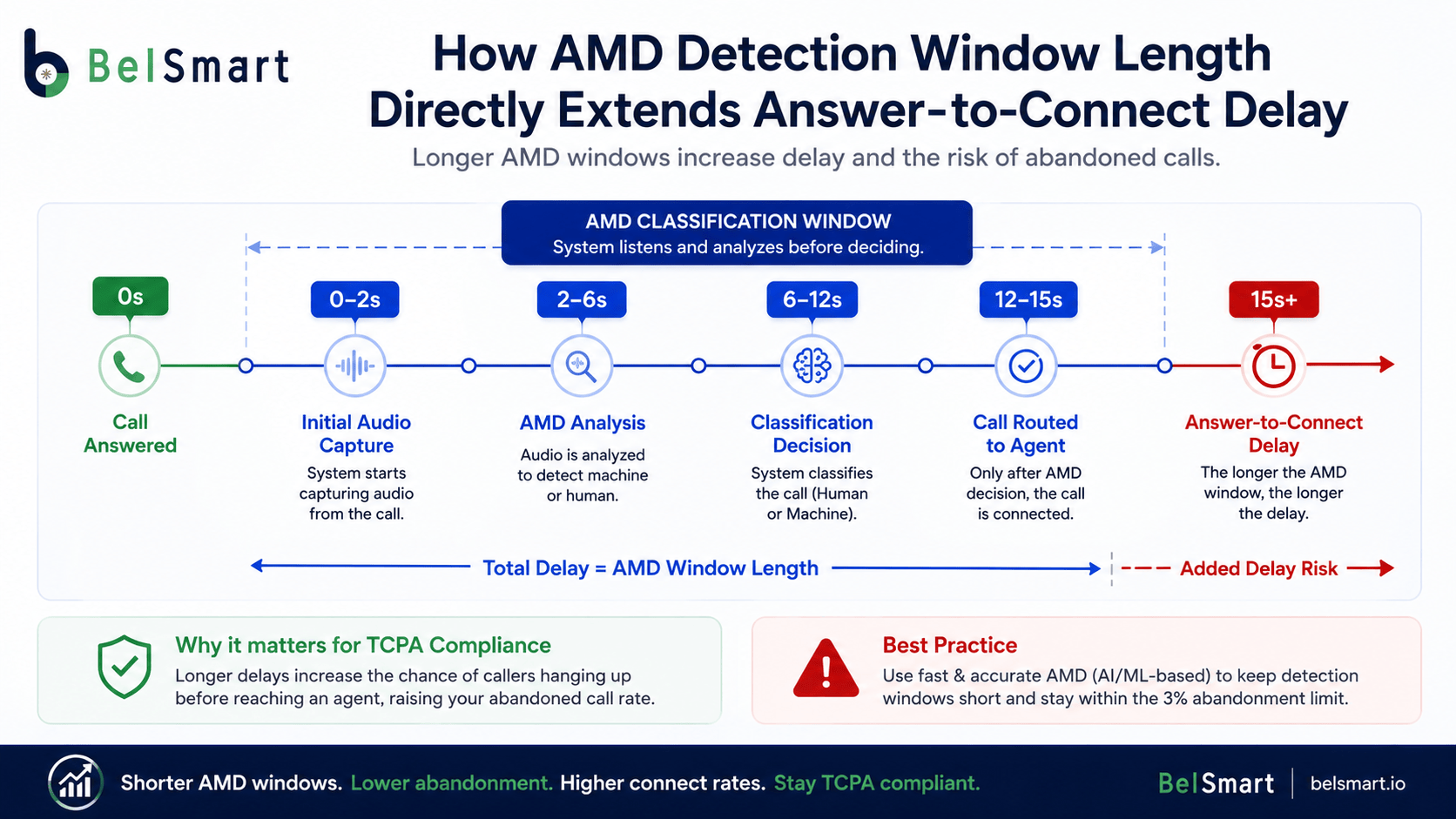
Where AMD Accuracy Has the Biggest Operational Payoff
High-volume outbound operations feel AMD accuracy the most directly, because they’re running the highest ratio of voicemail-to-human answers. In operations where 40–60% of answered calls are voicemails, the difference between an AMD system running at 75% accuracy and one running at 97% accuracy translates into a large number of agent-hours either wasted on misrouted calls or recovered for live conversations. This is exactly the profile of large-scale BPO call center operations, where dozens or hundreds of agents are running simultaneous campaigns and even a few percentage points of AMD accuracy compound into a measurable difference in daily connect volume.
How to Evaluate an AMD Vendor’s Accuracy Claims
Not every “accuracy” number on a vendor’s spec sheet is measuring the same thing. Before trusting a headline percentage, check:
- Is the number measured under real-world conditions, including modern carrier filtering and voicemail systems, or under lab conditions with older voicemail patterns?
- What’s the false positive rate specifically — not just overall accuracy — since a missed live human is a lost opportunity, not a minor inefficiency
- What’s the actual detection window the accuracy figure was measured at — a system quoting 95% accuracy at a 5-second window is solving a different, easier problem than one quoting 95% at under 2 seconds
- Does accuracy hold under production load, or only in isolated testing, since infrastructure degradation under high concurrency is a documented failure mode
Bottom line: an AMD accuracy number is only meaningful alongside its detection window and false positive rate. A vendor quoting one number without the other two is showing you the easiest possible version of their own results.
Frequently Asked Questions
How accurate is AI-based answering machine detection compared to legacy AMD?
Modern AI-powered AMD typically reaches 95–99% accuracy, while legacy rule-based systems often top out around 60–75% in real-world conditions — a gap driven mainly by AI’s ability to analyze speech cadence dynamically rather than relying on fixed silence-duration timers.
Why does AMD detection speed matter for TCPA compliance?
Because a call only counts as connected once it’s routed past AMD to an agent, a slower AMD window directly extends the answer-to-connect delay that the FCC’s 3% abandonment-rate rule is measuring — making AMD speed a compliance factor, not just a productivity one.
Can AMD ever be 100% accurate?
No. Every AMD method, including the most advanced AI-based classifiers, carries some rate of false positives and false negatives, since the underlying task — distinguishing a human “Hello?” from a machine greeting in a fraction of a second — is inherently probabilistic, not deterministic.
Does AMD accuracy stay consistent at high call volumes?
Not automatically. AMD performance can degrade under heavy server load if the underlying dialer infrastructure isn’t provisioned to sustain real-time audio processing at scale, which is why dialer architecture matters as much as the AMD model itself.
Which dialing mode benefits most from fast, accurate AMD?
High-volume, multi-line dialing modes like parallel dialing benefit the most, since every simultaneous line generates its own AMD decision, and any latency or accuracy shortfall compounds across the whole campaign rather than a single call.
See AI AMD accuracy tested against your own calling list.
Book a Personalized Demo See Plans & Pricing