AI Answering Machine Detection: How It Works and Why It Matters for Outbound Sales
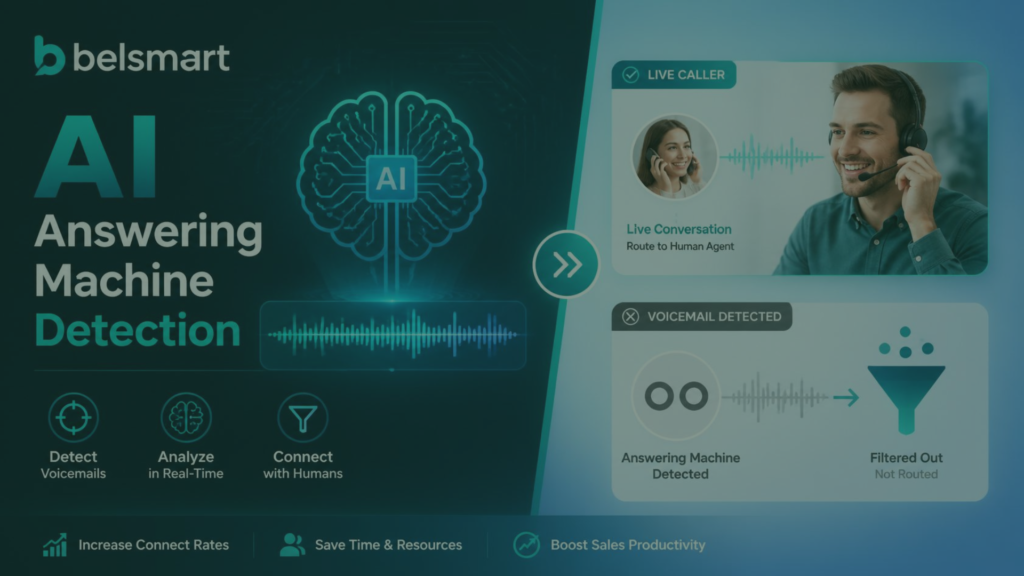
AI answering machine detection (AMD) is outbound dialer technology that analyzes the first seconds of an answered call to determine whether a human or a voicemail system picked up. It connects live answers to agents instantly, skips or drops messages on voicemails, and protects live connect rates, agent talk time, and TCPA compliance.
Most outbound dials never reach a live person. Depending on the list, industry, and time of day, a large share of connected calls terminate at voicemail — and every one of those calls that reaches an agent’s headset burns seconds that could have gone to a real conversation. Multiply that across a full shift, and voicemail screening quietly becomes the single largest source of wasted effort on an outbound floor.
This guide gives sales managers, SDR leaders, and call center operators a complete, factual breakdown of what answering machine detection is, how AI-based detection differs from legacy rule-based AMD, which speed and accuracy benchmarks matter, and how voicemail drop fits in. For a full overview of every dialing mode available today, see our Ultimate Guide to Outbound Dialer Software.
What’s in this guide:
- What Is Answering Machine Detection?
- How Does AI Answering Machine Detection Work?
- Rule-Based AMD vs. AI AMD: The Difference
- Why AMD Matters for Outbound Sales Productivity
- AMD Speed and Accuracy Benchmarks
- What Is Voicemail Drop?
- Who Needs AI Answering Machine Detection?
- How Belsmart’s AI AMD Solves These Problems
- Frequently Asked Questions
- Conclusion
What Is Answering Machine Detection?
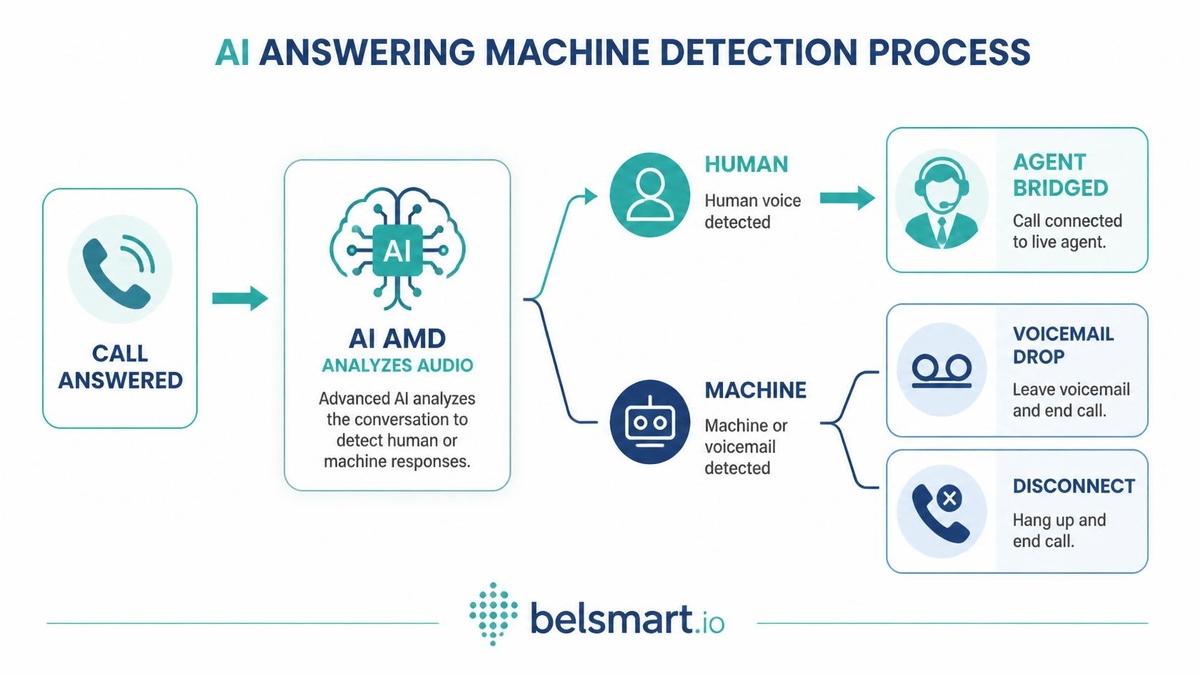
Answering machine detection is a real-time audio classification step that runs the instant an outbound call is answered. Within roughly the first one to four seconds of audio, the system must make a binary decision: a human answered, so the call is bridged to an available agent immediately — or a machine answered, so the agent stays free while the dialer disconnects, waits for the beep, or triggers an automated voicemail drop.
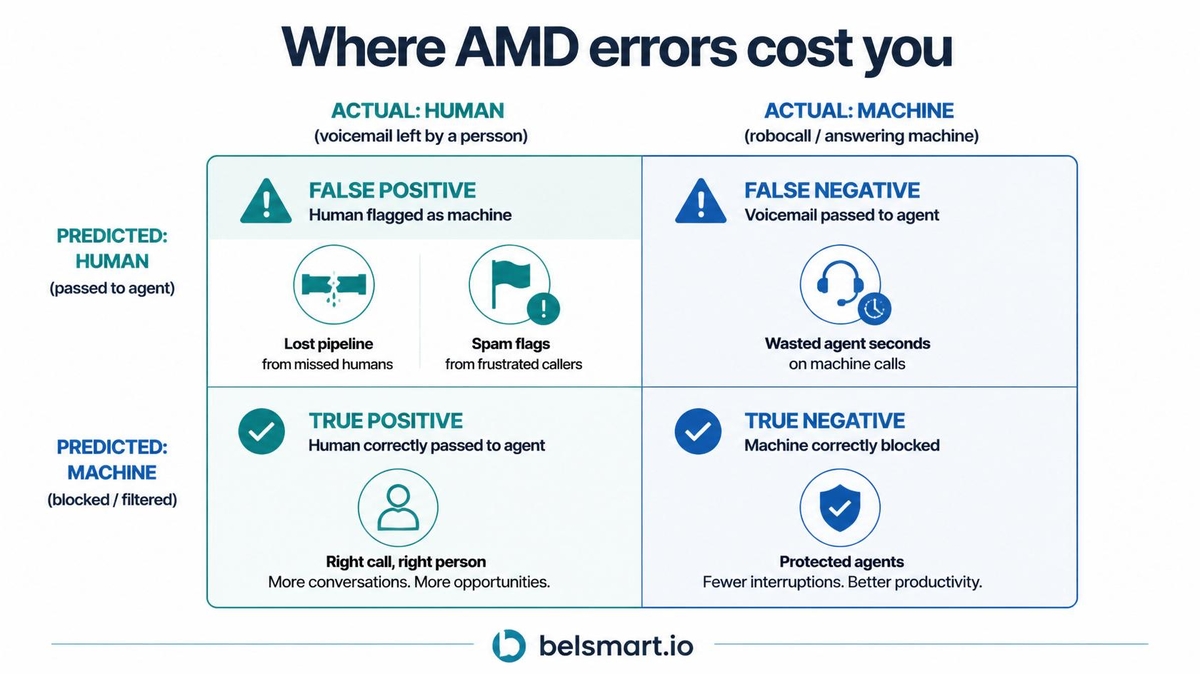
In an AMD outbound dialer, this classification is the gatekeeper for everything downstream. Power, parallel, and predictive dialers all rely on AMD to decide which answered calls deserve an agent’s attention. If it misclassifies, one of two things happens: agents sit through voicemail greetings (wasted capacity), or live prospects hear dead air (abandoned calls, spam flags, and complaints).
How AMD Fits Into Different Dialing Modes
AMD behaves differently depending on the dialing mode wrapped around it. In a Power Dialer, which places one call per agent, AMD’s main job is to skip voicemails quickly and log the disposition. In a Parallel Dialer, which launches several simultaneous lines per rep, AMD carries far more weight — it must classify multiple answers within a second or two and bridge only the live human. Parallel dialing without fast, accurate AMD produces dead-air calls at scale.
How Does AI Answering Machine Detection Work?
AI answering machine detection works by running a machine-learning audio classifier on the first moments of an answered call. Instead of counting words or measuring silence like legacy systems, the model has been trained on large labeled datasets of real answered calls, so it recognizes the acoustic signatures that separate live speech from recorded playback.
Step-by-Step Detection Flow
- Call is answered. The dialer opens the audio stream the instant the carrier signals an answer.
- The AI model analyzes the audio. Within the first one to two seconds, the classifier evaluates prosody, pitch variation, playback compression artifacts, room acoustics, and greeting patterns.
- Human detected → agent bridged. The call connects to an available agent before the prospect finishes saying hello, with a CRM screen pop for context.
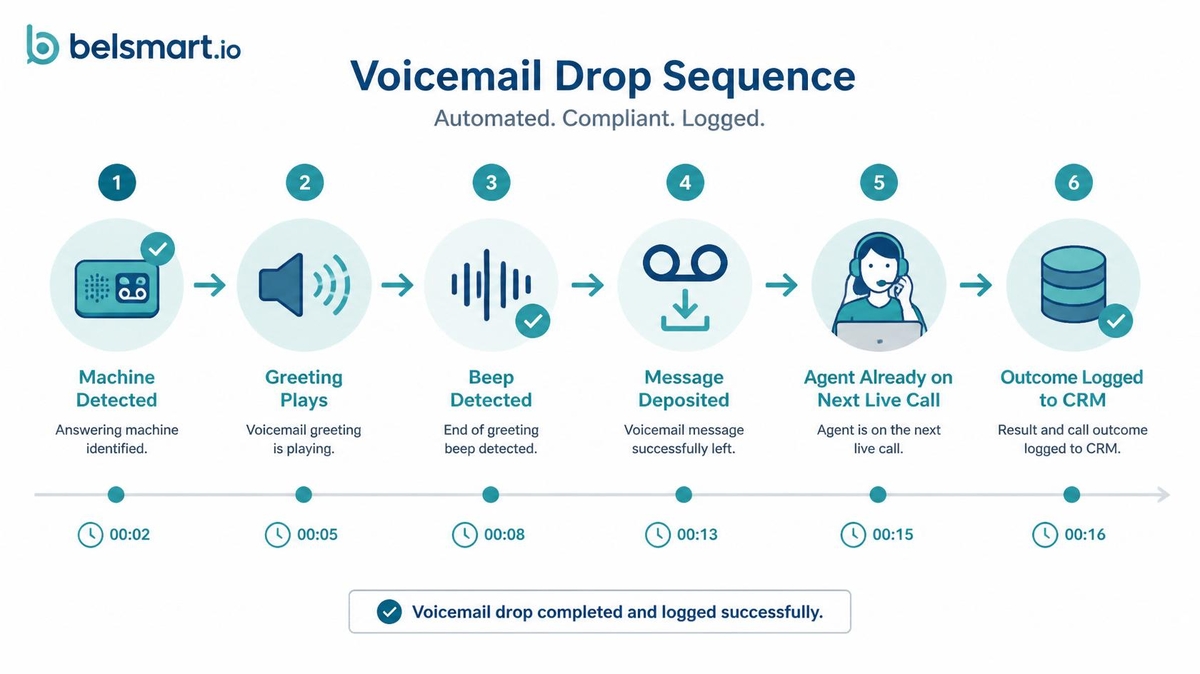
- Machine detected → automated handling. The system either disconnects, or waits for beep detection and delivers a voicemail drop.
- Outcome is logged. The classification (human, machine, drop delivered) is written back to the CRM as a call disposition, making detection accuracy auditable.
What Signals Does the AI Model Use?
Modern classifiers learn cues humans cannot easily articulate: micro-variations in pitch that only live voices produce, codec and compression artifacts typical of recorded greetings, background room acoustics, and beep frequencies. Because the model is trained rather than hand-coded, it can be retrained as carriers, languages, and greeting conventions change — something fixed rule sets cannot do.
Rule-Based AMD vs. AI AMD: The Difference
Traditional AMD — the kind documented in open-source telephony platforms for nearly two decades — relies on heuristics: greeting length, silence patterns, tone detection, and word-count thresholds. These rules work in ideal conditions but degrade quickly in the real world. A person answering “Hi, this is Priya from accounts payable, how can I help you?” looks statistically like a voicemail greeting. A terse recording (“Leave a message.”) looks like a human.
| Dimension | Rule-Based AMD | AI AMD |
|---|---|---|
| Method | Fixed heuristics: silence, tone, word count, greeting length | Neural audio classification trained on labeled call data |
| Typical accuracy | Commonly reported in the ~80–85% range in production | Typically mid-to-high 90% range; validate on your own traffic |
| Decision speed | Often 3–5+ seconds (waits for the greeting to complete) | Frequently under 2 seconds |
| Adaptability | Manual threshold tuning per market | Improves via retraining on new carriers, languages, greetings |
| Failure mode | Long-winded humans flagged as machines; short greetings pass as human | Lower error rates; requires periodic retraining to avoid drift |
Why AMD Matters for Outbound Sales Productivity
AMD performance flows directly into three operational KPIs that every outbound leader tracks.
1. Live Connect Rate
The live connect rate — the percentage of dials resulting in a conversation with a person — is the currency of outbound sales. A false positive (a human misclassified as a machine) is a silently discarded opportunity: the prospect answered, and the system hung up on them. On a large campaign, even a few percentage points of false positives destroy pipeline that no amount of agent coaching can recover, and the dead-air calls damage number reputation when prospects flag them as spam.
2. Agent Idle Time and Talk Time
Without effective AMD, agents personally screen every answered call — listening to greetings, waiting for beeps, manually disconnecting. Accurate detection returns that time to the queue. In parallel and predictive models, trustworthy AMD also allows a more aggressive dialing ratio, because the system can rely on its own classification when deciding how many lines to launch per available agent. That directly reduces agent idle time between conversations.
3. Compliance Exposure
In the United States, the FTC’s Telemarketing Sales Rule treats a call as “abandoned” if a live representative is not connected within two seconds of the called person’s completed greeting, and its safe-harbor provision caps abandoned calls at 3% of answered calls per campaign over a 30-day period. Slow or inaccurate AMD is one of the most common causes of breaching that threshold — every extra second the classifier deliberates is dead air in a prospect’s ear. See our guide to Outbound Compliance for the full regulatory picture.
AMD Speed and Accuracy Benchmarks
When evaluating voicemail detection software, four measurements separate serious platforms from checkbox features.
| Metric | What It Measures | Practical Target |
|---|---|---|
| Detection latency | Time from call answer to classification decision | Under ~2 seconds — the lower, the safer for abandonment thresholds |
| Overall accuracy | Correct classifications ÷ total answered calls | Validate ≥95% on your own traffic sample |
| False positive rate | Humans wrongly classified as machines (lost conversations) | Weight this most heavily — invisible in dashboards, but the costliest error |
| Beep detection reliability | Whether voicemail drops trigger after the tone, not over the greeting | Messages cut off mid-greeting signal weak beep detection |
How Do You Test AMD Accuracy on Your Own Campaigns?
Ask vendors to run detection against a sample of your recorded traffic, segmented by carrier and geography, rather than accepting a single global accuracy figure. Export 500–1,000 recorded answered calls with their AMD verdicts, have humans label each as person or machine, and compute overall accuracy plus separate false-positive and false-negative rates. Repeat quarterly — carrier behavior, greeting norms, and model drift all change AMD performance over time.
What Is Voicemail Drop?
Three implementation details determine whether voicemail drop helps or hurts:
- Beep timing precision. Messages that begin over the greeting arrive truncated (“…back to me at 555-0142”). Beep detection quality matters as much as human/machine classification.
- Message rotation. Identical messages left across an entire list accelerate spam-flagging on carrier analytics. Rotating scripts and localized caller IDs mitigate this.
- Consent and jurisdiction. Prerecorded messages fall under TCPA scrutiny in the US, and ringless voicemail remains an actively litigated area. Voicemail drop workflows should be gated by consent status in the CRM and reviewed with compliance counsel — one more reason AMD works best when the dialer is natively integrated with the system of record through a CRM Integration.
Who Needs AI Answering Machine Detection?
Any team dialing at volume benefits, but AMD delivers the largest gains where voicemail rates are highest and compliance stakes are real.
- Real Estate: High-volume follow-up on leads who screen unknown numbers heavily.
- Insurance: Quote follow-up and renewal outreach under strict prerecorded-message rules.
- Financial Services: Regulated outreach where abandoned-call thresholds carry legal weight.
- BPO Call Centers: Multi-client campaigns where agent utilization is the core economic metric.
- Home Services and Solar: Speed-to-lead races where every voicemail screened manually is a competitor’s head start.
- IT Services: Renewal and qualification outreach into switchboard-heavy B2B lists — the hardest AMD conditions of all.
The common thread is the ratio of voicemails to live answers. The higher it is, the more agent capacity AMD returns to the floor.
How Belsmart’s AI AMD Solves These Problems
Belsmart is a cloud-based outbound dialer platform built for sales teams and call centers that need speed without sacrificing compliance. Belsmart’s AI Answering Machine Detection classifies answered calls in under two seconds and works across every dialing mode — from the Power Dialer, where it skips voicemails and logs dispositions automatically, to the Parallel Dialer, where it screens multiple simultaneous lines and bridges only live humans to agents.
Every classification outcome — human, machine, or drop delivered — is written back to HubSpot, Salesforce, Zoho CRM, Pipedrive, and other systems through native CRM Integration, which makes AMD accuracy auditable rather than a black box. Voicemail drop, message rotation, and consent-gated automation run on the same TCPA-aware infrastructure covered in our Outbound Compliance framework, with Caller ID Spam Remediation protecting number reputation as drop volume scales.
If your team is deciding which dialing mode pairs best with AI AMD, see Power Dialer vs. Parallel Dialer vs. Predictive Dialer, or review Belsmart’s transparent pricing plans.
See Belsmart AI AMD in Action →
Frequently Asked Questions
What is answering machine detection in a dialer?
Answering machine detection is a real-time classifier that analyzes the first seconds of an answered outbound call to determine whether a human or a voicemail system picked up. Humans are bridged to agents instantly; machines are disconnected or receive an automated voicemail drop, keeping agents focused on live conversations.
How accurate is AI answering machine detection?
Legacy rule-based AMD is generally documented in the low-to-mid 80% range under real-world conditions, while machine-learning classifiers typically achieve accuracy in the mid-to-high 90% range. Because results vary by carrier and geography, teams should validate any figure against a labeled sample of their own recorded calls.
Why does AMD speed matter?
Every second the classifier deliberates is silence in the prospect’s ear. Slow AMD causes hang-ups, spam complaints, and abandoned calls — and the FTC’s safe harbor requires connecting a live agent within two seconds of the person’s completed greeting, with abandonment capped at 3% of answered calls per campaign over 30 days.
Is voicemail drop legal?
It depends on consent, message content, and jurisdiction. Prerecorded messages are regulated under the TCPA in the US, and ringless voicemail continues to face litigation. Voicemail drop should be gated by documented consent in your CRM and reviewed with compliance counsel before deployment.
Does AMD work with parallel dialing?
Yes — it is what makes parallel dialing viable. When several lines are launched per agent, AMD must classify each answer within a second or two and bridge only the live human. Parallel dialing without fast, accurate AMD produces dead-air calls at scale.
Can AMD results sync with my CRM?
Yes. Platforms with native CRM integration, including Belsmart, log each AMD outcome — human, machine, or voicemail drop delivered — as a call disposition in HubSpot, Salesforce, or Zoho CRM. This makes detection accuracy auditable and keeps voicemail drop gated by consent data stored in the system of record.
Conclusion
- AI answering machine detection is the classification gate that decides, in roughly the first two seconds, whether an answered call reaches an agent or is handled as voicemail.
- ML-based AMD outperforms rule-based heuristics on both speed and accuracy — but only an audit of your own recorded traffic tells you by how much.
- False positives (discarded humans) are the costliest and least visible error; weight them most heavily when tuning sensitivity.
- Detection latency is a compliance variable, not just a UX one — slow AMD drives abandoned-call rates toward the FTC’s 3% safe-harbor threshold.
- Voicemail drop multiplies AMD’s value but inherits TCPA obligations; gate it by consent data through your CRM integration, and see the Ultimate Guide to Outbound Dialer Software for how AMD fits into the full outbound stack.
Ready to stop paying agents to listen to voicemail greetings?
Try Belsmart’s AI AMD across Power and Parallel dialing modes. Book a Personalized Demo or See All Plans.