FCC Votes on TCPA Consent Revocation: Your 30-Day Action Plan for Outbound Call Centers
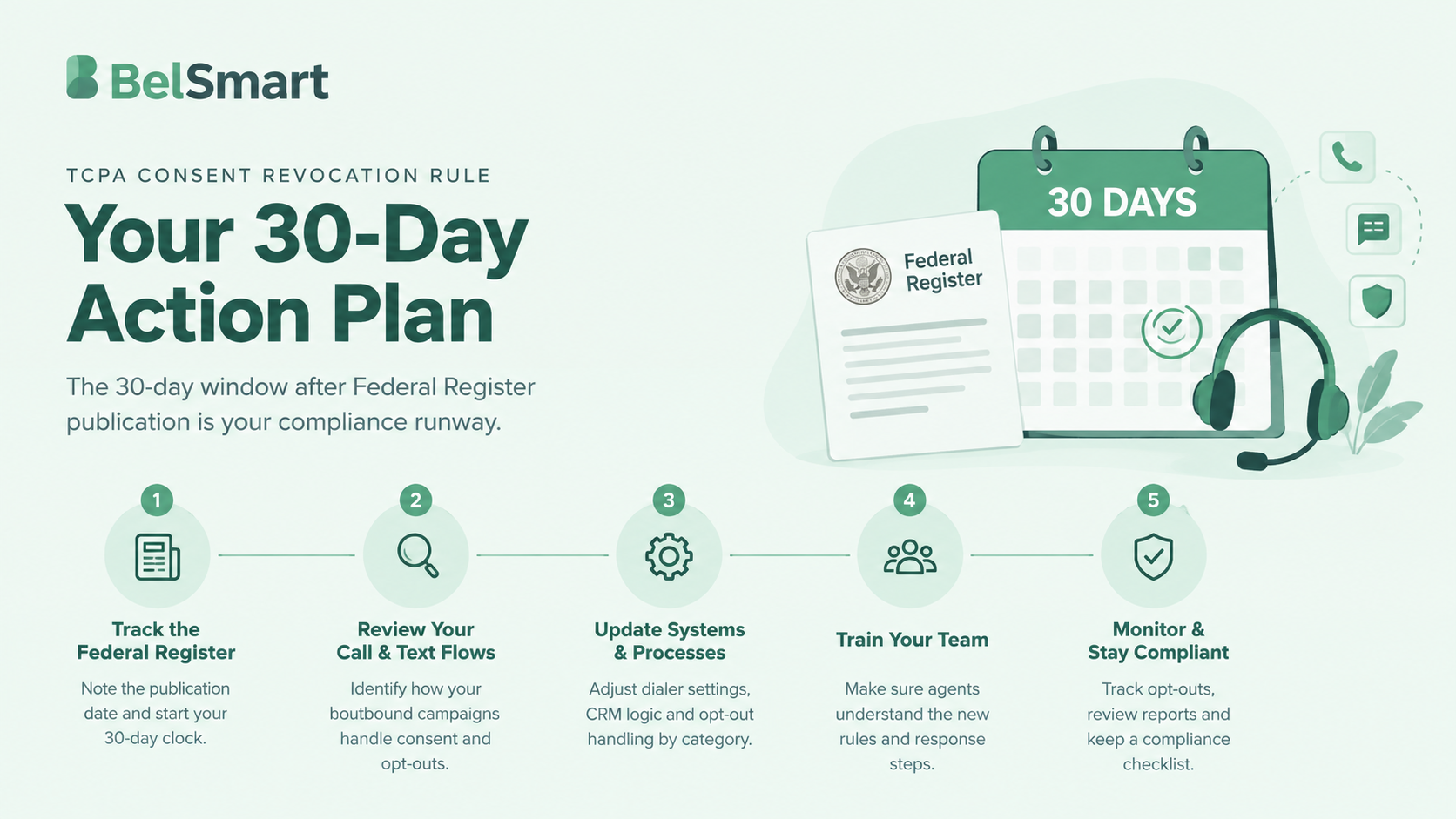
The FCC’s September 30, 2026 open meeting put the TCPA consent revocation overhaul on the table, and the clock for outbound call centers starts now. The new rules take effect 30 days after the final order is published in the Federal Register, replacing the January 31, 2027 “revoke all” deadline many teams were planning around.
In our pre-vote breakdown, we covered what the draft order would change. This follow-up is the practical part: what the order means for your dialer, scripts, and CRM, and a week-by-week plan so your team is ready on day one.
Last updated: October 1, 2026. This article is based on the order the FCC circulated on September 9, 2026 for its September 30 vote.
Status update: The FCC releases the final text of an adopted order after the meeting, and the adopted version can differ from the September 9 draft. Until the final text is out, use the draft as your working guide and confirm the details before you lock in changes. We will update this article when the order is published in the Federal Register.
What Does the New FCC Order Change for Outbound Teams?
The order replaces the 2024 “revoke all” rule with a narrower framework. Informational opt-outs become category-specific, callers can name an exclusive opt-out channel, and financial institutions get more room to send fraud alerts.
| Topic | 2024 rule | September 2026 order (as drafted) |
|---|---|---|
| Informational opt-out scope | Revokes consent to all calls and texts from that caller | Can apply only to the category of informational message the consumer opted out of |
| Telemarketing opt-out scope | Revokes all future telemarketing | Unchanged: still revokes all future telemarketing |
| Accepted opt-out methods | Any reasonable method, and callers must honor all of them | Callers can designate one or more exclusive methods, if clearly disclosed |
| No method designated | Not applicable | Caller must keep honoring any reasonable method |
| Fraud alerts from financial institutions | Only to numbers the customer provided | Also to numbers from reliable sources, such as an authorized family member or caller ID |
Source: Troutman Pepper Locke, September 17, 2026.
1. Informational opt-outs become category-specific
An informational message has no advertising or telemarketing content, such as an appointment reminder, payment notice, or delivery update. Under the order, a consumer who opts out of debt collection calls would not automatically be opted out of fraud alerts or appointment reminders from the same company.
2. You can name your official opt-out channel
Callers may designate one or more of three methods as the exclusive way to revoke consent:
- An automated, interactive voice or key-press opt-out on the call
- A text reply using a standard keyword: stop, quit, end, revoke, opt out, cancel, or unsubscribe
- A website or phone number set up to process opt-outs
If you designate a method and disclose it clearly and conspicuously on the call or in the text, you don’t have to process opt-outs that come in some other way. If you don’t designate one, the “any reasonable means” standard still applies.
3. Fraud alerts get more room
Banks and other financial institutions can send exempt fraud-alert calls and texts to wireless numbers obtained from reliable sources, not only numbers the customer provided directly. This matters most for financial services call centers.
Takeaway: the order gives callers more flexibility on informational messages, but every new option depends on knowing which messages are informational and which are telemarketing.
What Did Not Change?
The order does not loosen the rules for sales calls. Outbound sales, lead generation, and BPO teams should keep these points front and center:
- Telemarketing opt-outs still cover everything. One opt-out from a sales call or promotional text still revokes consent to all future telemarketing from your company, across every campaign and line of business.
- Mixed messages count as telemarketing. If a reminder or service message includes any promotional content, treat it as telemarketing. When in doubt, classify it that way.
- The 10-business-day deadline stays. You must still honor revocations within a reasonable time, and no later than 10 business days after you receive them.
- Existing opt-out mechanisms stay in place. Prerecorded or artificial-voice calls that include an advertisement or telemarketing must still offer an automated voice or key-press opt-out to make a do-not-call request.
- Damages are unchanged. The TCPA still allows statutory damages of $500 per violation, up to $1,500 for willful or knowing violations, and TCPA class actions remain among the most active areas of consumer litigation in the U.S.
Takeaway: for outbound sales teams, the core rule is the same. One telemarketing opt-out still stops all your sales outreach to that consumer.
When Do the New TCPA Opt-Out Rules Take Effect?
The new rules don’t take effect the day after the vote. They take effect 30 days after the order is published in the Federal Register, which usually happens a few weeks after a meeting. That gives most teams roughly one to two months, but the exact date isn’t set until publication.
| Milestone | Date |
|---|---|
| Draft order circulated (FCC-CIRC 2609-05) | September 9, 2026 |
| FCC open meeting vote | September 30, 2026 |
| Final order text released | Shortly after the meeting |
| Federal Register publication | To be announced |
| New revocation rules take effect | 30 days after Federal Register publication |
| Comments due on the Further Notice | 30 days after publication |
| Reply comments due | 60 days after publication |
| Old “revoke all” effective date | January 31, 2027, now superseded |
Takeaway: follow CG Docket No. 02-278 on the FCC’s electronic filing system and set an alert for the Federal Register notice. That publication date sets your compliance deadline.
Your 30-Day Action Plan
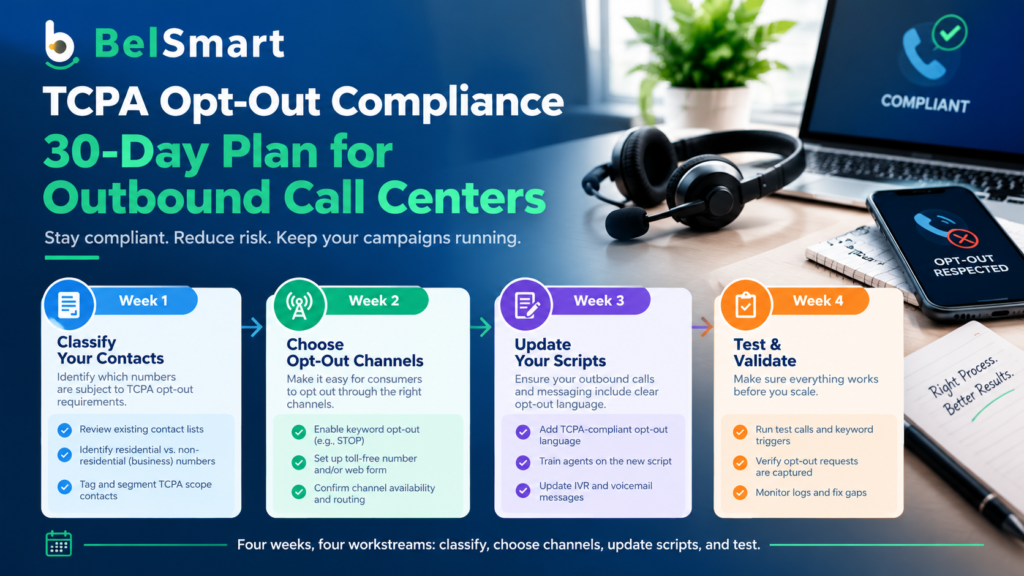
The teams that handle this well will treat the effective date as a launch deadline, not a legal footnote. Here’s a week-by-week plan your operations, compliance, and sales leaders can work through together.
Week 1: Classify every campaign
The new rules only help you if you know which messages are informational and which are telemarketing.
- List every outbound call, text, voicemail drop, and IVR campaign you run.
- Tag each one as informational or telemarketing, and document why.
- Flag mixed campaigns, like a reminder text with a promo link, and treat them as telemarketing.
- Name an owner for each campaign’s classification so it stays current.
Week 2: Choose your opt-out channels
Decide whether to designate exclusive opt-out methods. For most outbound teams, a combination works best.
- Voice campaigns: Offer a key-press or voice opt-out in your IVR and prerecorded messages, such as “Press 9 to stop receiving these calls.”
- Texting campaigns: Support the standard keywords: STOP, QUIT, END, REVOKE, OPT OUT, CANCEL, and UNSUBSCRIBE.
- Backup channel: Set up a dedicated opt-out web page or phone number for consumers who want another option.
- Confirm the decision with your legal counsel before you roll it out.
Week 3: Update scripts and disclosures
An exclusive opt-out method only protects you if it’s disclosed clearly and conspicuously.
- Add opt-out language to every text template, such as “Reply STOP to opt out.”
- Add the opt-out prompt to every IVR flow and prerecorded message.
- Update live-agent scripts so reps state the opt-out method on the call.
- Retrain agents to recognize and log verbal opt-out requests, especially on sales calls.
Week 4: Fix your data and test end to end
Category-specific opt-outs only work if your systems store consent by category, not as one yes-or-no field.
- Store consent and revocation status per message category in your CRM.
- Make sure a telemarketing opt-out suppresses the number across all sales campaigns, not only the one that triggered it.
- Sync opt-outs between your dialer, SMS platform, and CRM so every system sees them.
- Confirm opt-outs are processed well within 10 business days, and aim for same-day.
- Test each opt-out path yourself: press the key, text STOP, and use the web form, then confirm the number is suppressed.
- Keep audit records of every opt-out, including the date, channel, and category.
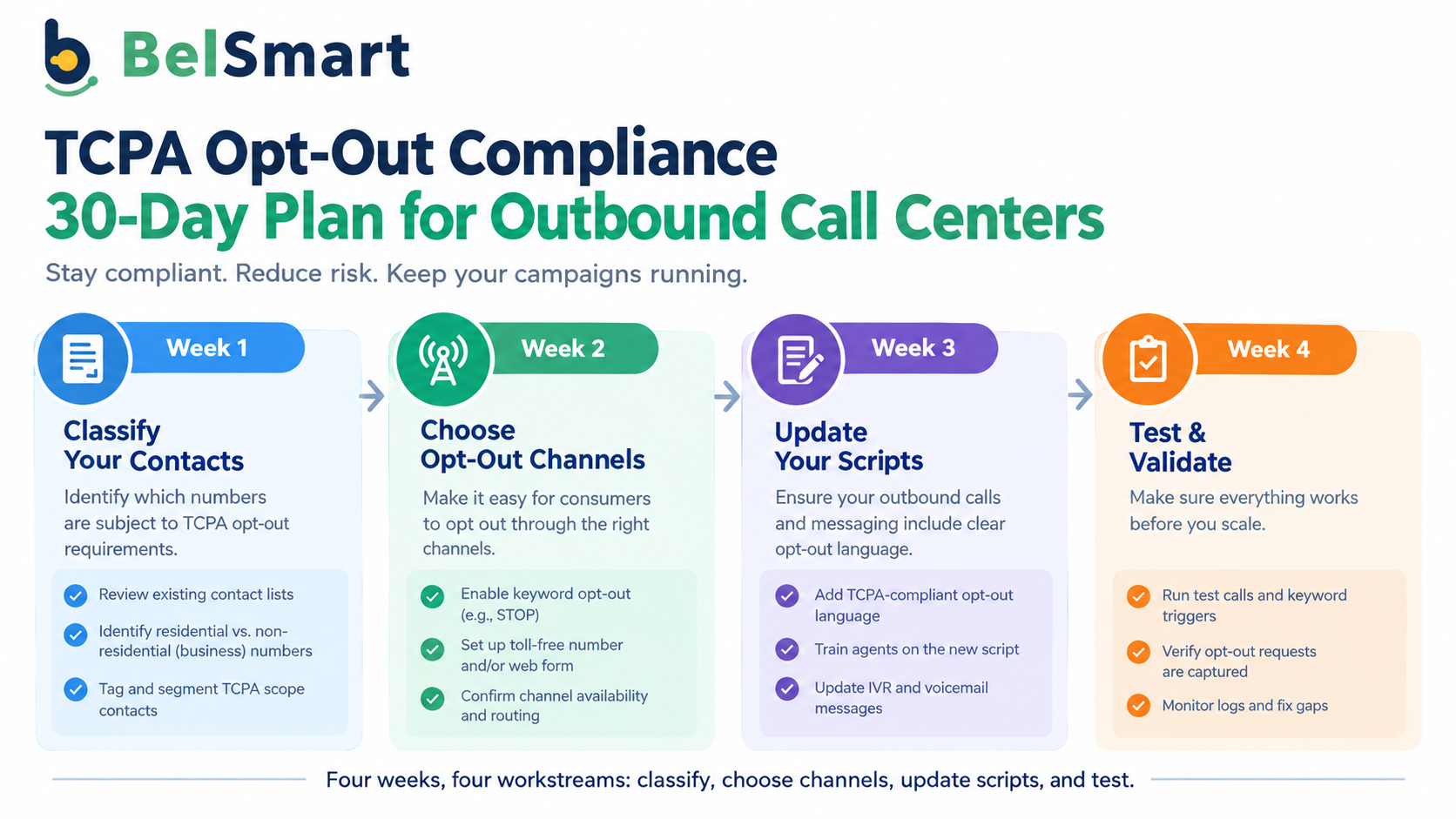
Takeaway: start with classification. Every other step, from choosing opt-out channels to updating your CRM, depends on it.
See How Belsmart Handles Opt-Outs
Watch campaign-level DNC, IVR opt-outs, and CRM sync work together in a live demo.
Do State Telemarketing Laws Still Apply?
Yes. The FCC order changes federal rules only. Several states, including Florida, Oklahoma, and Maryland, have their own telemarketing laws, often called “mini-TCPAs,” with their own consent rules, calling-hour limits, call-frequency caps, and private rights of action.
A practice that’s fine under the new federal rule can still create risk under state law, so check the rules in every state you call into. Calling-window enforcement based on each contact’s local time zone and state is one of the simplest ways to reduce that risk.
Takeaway: federal flexibility doesn’t override stricter state rules, so build your process to the toughest standard in the states you dial.
What Could Tighten Next?
Alongside the order, the FCC opened a Further Notice of Proposed Rulemaking (FNPRM) that asks whether to:
- Cut the deadline to honor opt-outs from 10 business days to seven
- Require two-way texting, so consumers can always reply to opt out
- Require a one-step “revoke all” option as a condition of using category-specific opt-outs
- Clarify how opt-outs apply across affiliates, divisions, and separate lines of business
- Shorten the list of standard opt-out keywords
- Allow a single confirmation message after an opt-out, sent by the end of the next business day
None of these are final, but they show where the rules may head. If your systems already process opt-outs the same day and sync them everywhere, a shorter deadline won’t catch you off guard.
Takeaway: treat the new order as a minimum, not a finish line.
How Belsmart Helps You Get Ready
Compliance rules change, but the work stays the same: capture every opt-out, apply it everywhere, and prove it later. Belsmart is a cloud-based outbound dialer that builds that into the dialing workflow instead of leaving it to spreadsheets.
| What the new rules require | How Belsmart supports it |
|---|---|
| Separate informational and telemarketing outreach | Run each type as its own campaign with its own lists, scripts, and dispositions |
| Offer a clear opt-out on calls | Build IVR flows and prerecorded messages with a key-press opt-out prompt |
| Honor opt-outs across every sales campaign | Manage DNC lists by campaign, block numbers instantly, and import or export entries in bulk |
| Keep every system in sync | Two-way CRM integration with HubSpot, Salesforce, Zoho CRM, Pipedrive, and Freshsales, with disposition-triggered workflows |
| Make sure agents disclose and log opt-outs | Show updated scripts in the agent workspace and capture opt-outs as one-click dispositions |
| Prove compliance later | Call recording, automatic call logging, and audit-ready history for every contact |
| Respect state calling rules | Calling-window enforcement based on each contact’s local time zone |
Belsmart’s omnichannel contact center platform brings voice, SMS, email, chat, and WhatsApp into one place, so opt-outs don’t get stuck in a single channel. For outsourcers, Belsmart’s BPO call center software supports separate client campaigns, each with its own suppression rules.
TCPA and DNC compliance controls are included in every Belsmart plan, from the Launch manual dialer to the Accelerate power dialer. See plans and pricing.
Bringing It Together
The FCC’s new consent revocation framework is good news for teams that send reminders, notices, and other wanted informational messages. For outbound sales teams, though, the core rule hasn’t changed: one telemarketing opt-out still stops all your sales outreach to that consumer.
The call centers that come out ahead will classify their campaigns, name their opt-out channels, and wire opt-outs into every system before the effective date arrives.
Frequently Asked Questions
When do the new TCPA consent revocation rules take effect?
They take effect 30 days after the final order is published in the Federal Register. That date replaces the January 31, 2027 effective date for the old “revoke all” rule.
Does one opt-out still stop all my sales calls?
Yes. A revocation in response to a telemarketing call or text still revokes consent to all future telemarketing from your company. The category-specific change applies only to informational messages.
Can I ignore opt-out requests that come through other channels?
Only if you’ve designated an exclusive opt-out method and disclosed it clearly on the call or in the text. If you haven’t, you must still honor any reasonable opt-out request, such as a consumer telling your agent to stop calling.
How long do I have to process an opt-out?
No more than 10 business days. The FCC is considering cutting that to seven, so aim to process opt-outs the same day.
Do the new rules override state telemarketing laws?
No. State laws in places like Florida, Oklahoma, and Maryland still apply, and some are stricter than federal rules. Check the rules in every state you call into.
What should outbound call centers do first?
Start by classifying every campaign as informational or telemarketing. Every other step, from choosing opt-out channels to updating your CRM, depends on that classification.
This article is for informational purposes only and is not legal advice. TCPA and state telemarketing rules are complex and fact-specific, so talk with qualified legal counsel before changing your consent and opt-out practices. Sources: Troutman Pepper Locke and Belsmart’s pre-vote analysis.
Get Ready Before the Clock Runs Out
Book a personalized demo and see how Belsmart’s campaign-level DNC, IVR opt-outs, and CRM sync fit your outbound compliance process.
Questions about TCPA opt-out workflows? sales@belsmart.io. We reply within one business day.