Caller ID Management: How to Stop Your Numbers From Getting Flagged as Spam
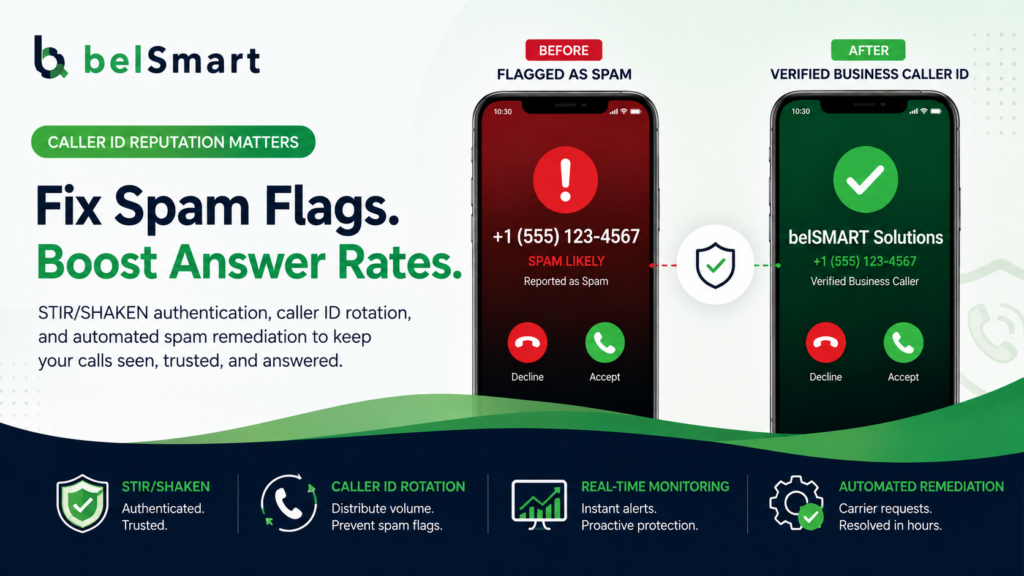
A caller ID flagged as spam means a carrier’s call-analytics engine has attached a label — “Spam Likely,” “Scam,” or “Potential Fraud” — to an outbound number before the recipient even sees it ring. The fix requires a combination of STIR/SHAKEN authentication, caller ID rotation, reputation monitoring, and formal carrier remediation requests. Most outbound teams lose 20–30% of their answer rate to this problem before they even realize it’s happening.
If your sales team’s connect rate has quietly dropped over the last few weeks with no change in your list quality or calling hours, a spam label is the most likely culprit — not agent performance.
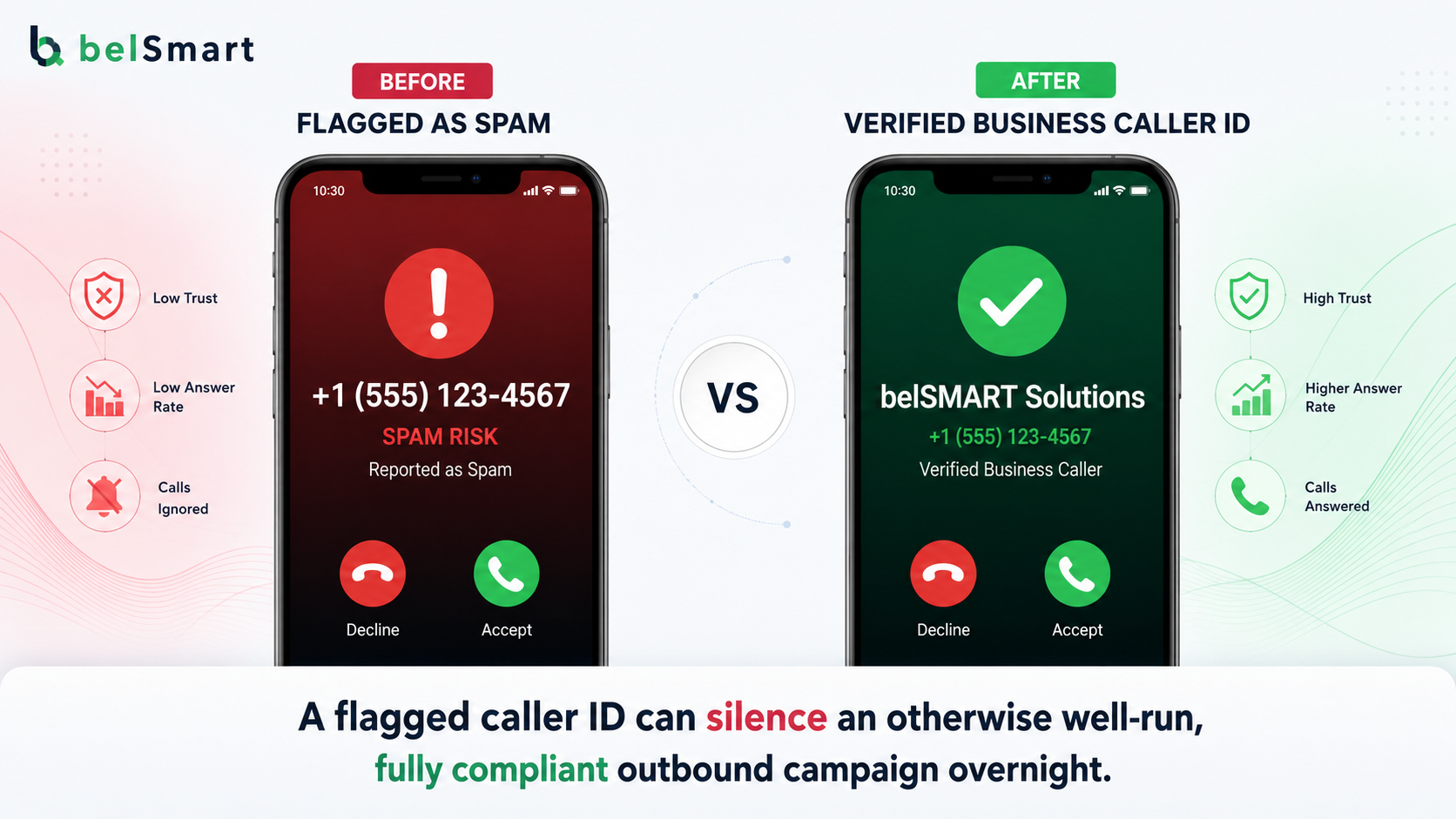
Why Do Business Phone Numbers Get Flagged as Spam Likely?
Carriers like AT&T, Verizon, and T-Mobile run automated analytics engines that score every outbound number in near real time, independent of who owns it or why they’re calling. A number gets flagged when its calling pattern statistically resembles known spam or robocall behavior — regardless of intent.
The most common triggers are:
- High call volume in a short window. Dialing dozens of numbers per hour from a single line looks identical to a robocall operation to carrier algorithms.
- Elevated hang-up or complaint rates. If a meaningful share of recipients hang up within seconds or report the call, that feeds directly into the number’s reputation score.
- Calling outside normal business hours. Off-hours outbound activity is a strong spam signal to carrier models.
- Missing STIR/SHAKEN authentication. Unsigned or improperly signed calls are inherently less trusted and more likely to be labeled or blocked outright.
- No listing in carrier reputation registries. A number that has never been formally registered as a legitimate business line has no positive signal to offset the negative ones.
Key point: Even a fully compliant, well-run outbound campaign can get mislabeled — carrier algorithms are sensitive, and false positives are common. That’s why remediation, not just prevention, has to be part of the process.
What Is STIR/SHAKEN and How Does It Affect Caller ID Trust?
STIR/SHAKEN is an FCC-mandated authentication framework that lets carriers cryptographically verify that the caller ID displayed on a call actually matches the number that originated it. The originating carrier “signs” the call with a digital certificate, and the terminating carrier checks that signature before the call reaches the recipient’s phone.
Every signed call receives one of three attestation levels:
| Attestation Level | What It Confirms | Typical Outcome for the Call |
|---|---|---|
| A – Full Attestation | The carrier verified both the caller’s identity and their legitimate right to use that specific number | Highest trust; lowest spam-label risk |
| B – Partial Attestation | The carrier verified the caller’s identity, but not their right to the specific number | Moderate trust; some spam-label risk |
| C – Gateway Attestation | The call entered the network from an untrusted or international source with no verification | Lowest trust; high spam-label risk |
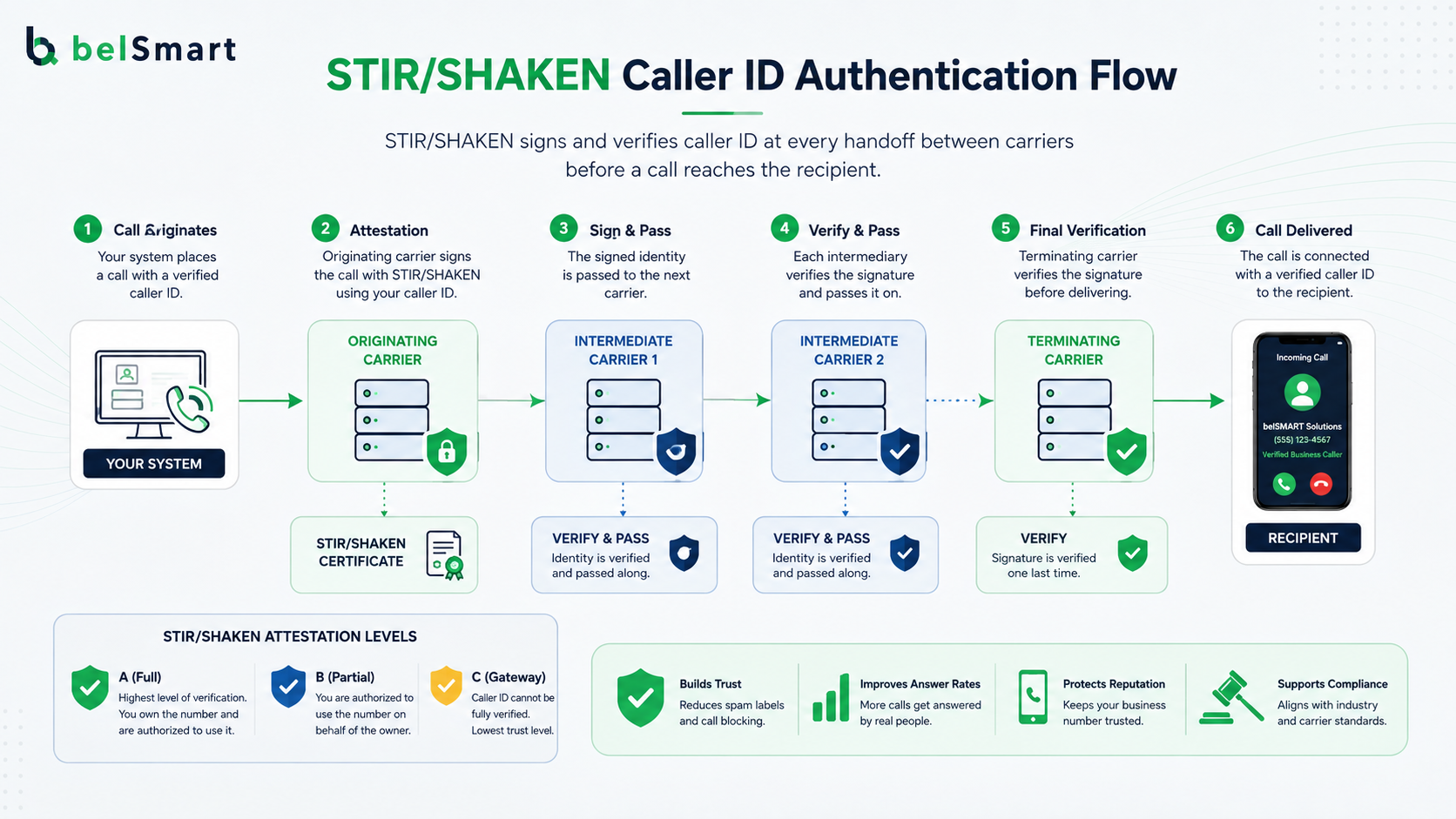
The FCC first mandated STIR/SHAKEN implementation on IP networks by June 30, 2021, under the TRACED Act, specifically to reduce spoofed and illegally labeled robocalls. Outbound dialer platforms that don’t properly configure attestation on your behalf are effectively asking carriers to trust your calls less by default — regardless of how compliant your actual calling practices are.
How Do You Fix a Caller ID Already Flagged as Spam?
Once a number is flagged, waiting it out rarely works — the label persists until it’s actively challenged. The remediation process generally follows four steps:
- Detect the flag in real time. Monitor outbound numbers across major carriers and analytics providers so you know within minutes of a flag appearing, not weeks later when your connect rate has already dropped.
- Submit a carrier remediation request. Each carrier and analytics engine (Hiya, First Orion, TNS, etc.) has its own dispute process requiring evidence that the number is a legitimate business line.
- Register the number in reputation registries. Formal registration, including the Free Caller Registry, gives carriers a positive trust signal to weigh against any negative call-pattern data.
- Confirm STIR/SHAKEN attestation is correctly configured. An unsigned or C-level attestation call is far more likely to be re-flagged even after a successful remediation request.
Manual remediation typically means filling out carrier dispute forms and waiting one to several weeks per number, with no visibility into status in the meantime. Belsmart’s built-in caller ID spam remediation automates this entire pipeline — detection, carrier submission, and registry management — across every plan, so flagged numbers get resolved in hours rather than weeks.
How Does Caller ID Rotation Prevent Future Flags?
Caller ID rotation automatically substitutes a clean, unflagged number in place of one that’s approaching risk thresholds — before it gets labeled, not after. Instead of running every outbound call through a single number until it burns out, the dialer distributes call volume across a pool of numbers and continuously monitors each one’s reputation status.
This matters most on high-volume dialing modes. Belsmart’s Power Dialer and Parallel Dialer both monitor and rotate caller IDs automatically, auto-substituting clean numbers before a spam-likely flag can impact answer rates — which is especially important on Parallel Dialer campaigns running multiple simultaneous lines per agent, where call volume per number climbs fastest.
Is Caller ID Spam Remediation Different From TCPA Compliance?
Yes — they solve two separate problems that are often confused. TCPA compliance governs whether you’re legally allowed to make a call (consent, do-not-call scrubbing, calling-hour restrictions), while caller ID spam remediation governs whether the call gets seen and answered once it’s legally placed. A campaign can be fully TCPA-compliant and still suffer a collapsed answer rate because of an unrelated spam label.
Belsmart’s outbound compliance tools handle the legal side — DNC scrubbing, consent logging, and abandoned call rate controls — while spam remediation and caller ID rotation handle the deliverability side. Teams evaluating dialing ratios for TCPA risk should also review how dialer ratios affect abandoned call exposure, since ratio and caller ID health compound each other on high-volume campaigns.
Bottom line: being legally allowed to make the call and being able to get it answered are two different problems — solving only one still leaves your connect rate exposed.
How Belsmart Automates Caller ID Management
Belsmart bundles caller ID spam remediation into the core outbound dialer platform rather than selling it as a separate add-on. The system continuously monitors every outbound number across AT&T, Verizon, T-Mobile, and major analytics providers, issues instant alerts the moment a number is flagged, and automatically submits remediation requests to the appropriate carrier and reputation registry — all without manual form submissions or support tickets.
- Real-time monitoring across all major carriers and analytics providers
- Instant flag alerts the moment a number is labeled Spam Likely, Scam, or Fraud
- Automated carrier remediation requests — no manual dispute forms
- Automatic caller ID rotation built into Power and Parallel dialing modes
Combined with automatic caller ID rotation on the Power and Parallel dialing modes, this keeps outbound answer rates stable even on high-volume, multi-agent campaigns.
Frequently Asked Questions
Why did my business number suddenly get labeled “Spam Likely”?
Carrier analytics engines flag numbers based on calling patterns, not intent — high call volume in a short window, elevated hang-up rates, off-hours dialing, or missing STIR/SHAKEN authentication can all trigger a flag, even for a fully legitimate, TCPA-compliant campaign.
How long does it take to remove a spam label from a caller ID?
Manual carrier disputes typically take one to several weeks per number with limited status visibility. Automated remediation platforms that submit carrier requests directly can resolve flags in hours rather than weeks.
Does STIR/SHAKEN guarantee my calls won’t be flagged as spam?
No. STIR/SHAKEN verifies that your caller ID matches your actual number, which reduces spam-label risk, but carriers still separately score calls based on volume and complaint patterns. Authentication and reputation management work together, not as substitutes for each other.
What’s the difference between caller ID rotation and caller ID spoofing?
Caller ID rotation cycles between multiple numbers your business legitimately owns and has authenticated. Spoofing falsifies a number you don’t own or control — it’s the exact behavior STIR/SHAKEN was