
What Is an Abandoned Call Rate — and What’s the Legal Limit?
What is an abandoned call rate?
An abandoned call rate is the percentage of answered outbound calls where no live agent becomes available to speak with the prospect within a defined window — typically two seconds. Under FCC regulations, outbound dialer campaigns in the United States must keep this rate at or below 3% of all calls answered by a live person, measured over each 30-day rolling calling campaign. Exceeding this limit is a TCPA violation carrying fines of $500 to $1,500 per call.
Key Facts About Abandoned Call Rate
- The FCC’s legal limit is 3% per 30-day rolling period, calculated per calling campaign
- An abandoned call is defined as a live answer with no agent connection within 2 seconds
- TCPA violations carry fines of $500–$1,500 per call, with over 2,700 TCPA cases filed in the US in 2024
- Predictive and parallel dialers carry the highest abandoned call risk by design
- Power dialers operate at a 1:1 ratio and virtually eliminate abandoned call risk
- Properly configured pacing algorithms can keep abandonment under 1% even at high call volumes (Belsmart platform data)
Every outbound sales team dialing at scale eventually runs into the same question: how many calls can we place per agent before we cross a legal line? The answer isn’t a matter of preference — it’s a specific, federally enforced number, and getting it wrong is one of the most common and most expensive compliance mistakes an outbound campaign can make.
Abandoned call rate sits at the center of that risk. It’s a metric that sounds purely operational — a measure of dialer efficiency — but it’s actually a regulatory tripwire. This guide explains exactly what abandoned call rate is, how it’s calculated, what the FCC’s legal limit requires, which dialing modes create the most risk, and the specific steps outbound teams take to stay compliant without sacrificing call volume.
1. What Is an Abandoned Call?
An abandoned call is any outbound call that a live person answers, but where no agent is available to speak with them within a defined connection window — set by the FCC at two seconds. When this happens, the prospect either hears silence, a delayed greeting, or the call disconnects entirely before an agent picks up.
Abandoned calls are a byproduct of a specific dialing strategy, not an accident. Predictive and parallel dialers intentionally place more outbound calls than there are available agents, betting that a meaningful percentage of those calls won’t be answered at all. The dialer’s goal is to have a live person answer at almost exactly the same moment an agent becomes free. When the math doesn’t line up, the excess calls become abandoned.
This is fundamentally different from a manual or power dialer, where the dialing system only ever places one call per available agent, making abandonment structurally impossible rather than something that needs to be monitored and controlled.
Abandoned Call vs. Dropped Call vs. Missed Call
| Term | Definition | Regulatory Relevance |
|---|---|---|
| Abandoned Call | A live-answered call with no agent connection within 2 seconds | Directly regulated — 3% FCC limit |
| Dropped Call | A call disconnected mid-conversation due to a technical or network failure | Not separately regulated, but a quality issue |
| Missed Call | An outbound call that rings without being answered by the recipient | Not regulated — a normal campaign outcome |
2. What Is Abandoned Call Rate?
Abandoned call rate is the percentage of all live-answered outbound calls in a campaign that result in an abandoned call, calculated on a rolling basis. It’s the metric regulators use to measure whether a dialer’s pacing — the ratio of calls placed to agents available — is operating within legal bounds.
The Formula
This calculation only counts calls answered by a live person — voicemails, busy signals, disconnected numbers, and no-answers are excluded from the denominator entirely. That means abandoned call rate isn’t diluted by unanswered dials; it’s a pure measure of what happens the moment a real person picks up.
The real compliance requirement is measured over a rolling 30-day window, which means a single high-volume, poorly paced day can push the monthly average over the line even if most days stay comfortably under it.
3. What Is the Legal Limit for Abandoned Call Rate?
The FCC’s legal limit for abandoned call rate is 3%, measured per calling campaign over each 30-day rolling period, under the Telephone Consumer Protection Act (TCPA) and its associated FCC regulations.
- The 3% cap applies per campaign, not per company. Each individual campaign must stay under 3% — not an average across all campaigns.
- The measurement window is rolling, not calendar-month. Compliance is assessed continuously; there’s no monthly reset.
- The limit applies specifically to live-answered calls. Lower live-answer rates mean less room for error on each abandoned call.
- Abandoned calls that do connect to an automated message must be compliant — identifying the calling company and offering a callback or opt-out.
For the full compliance landscape — including DNC scrubbing, consent logging, and the FCC’s one-to-one consent rule — see the TCPA Compliance for Outbound Sales Teams guide.
4. Which Dialing Modes Carry the Most Abandoned Call Risk?
Abandoned call risk is not evenly distributed across dialing modes — it’s a direct function of how aggressively a platform paces calls relative to agent availability.
| Dialing Mode | How It Paces Calls | Abandoned Call Risk |
|---|---|---|
| Manual Dialer | Agent initiates every call individually | None |
| Preview Dialer | Agent reviews contact, then dials | Very low |
| Power Dialer | 1:1 ratio — one call per available agent | Very low |
| Parallel Dialer | Multiple lines dialed per agent simultaneously | Moderate |
| Predictive Dialer | Algorithmic over-dialing based on predicted answer rates | Highest |
Manual and preview dialers carry effectively no abandoned call risk because the dial itself is gated behind agent availability. Power dialers extend this same guarantee through automation. Parallel and predictive dialers work differently by design — the entire value proposition of three to five times more live connections per hour comes from calculated over-dialing, which is exactly why they require built-in pacing controls as a non-negotiable feature. For a deeper comparison, see Power Dialer vs Parallel Dialer vs Predictive Dialer: The Complete 2026 Comparison.
5. How to Calculate and Monitor Abandoned Call Rate
Staying compliant requires more than knowing the formula — it requires monitoring the number continuously, not retroactively.
Real-Time Rate Tracking
Abandoned call rate needs to be visible on a live dashboard, not reconstructed after the fact. A supervisor watching a parallel dialer campaign can adjust pacing the moment the rate trends upward — before it accumulates into a 30-day violation.
Rolling 30-Day Calculation, Not Daily Reset
Monitoring tools need to calculate the rate on a continuously moving window. Daily or monthly-only reporting can mask a slow drift toward non-compliance that only becomes visible once the violation has already occurred.
Per-Campaign Segmentation
Since the FCC’s 3% limit applies per campaign, monitoring must be segmented accordingly. A blended rate across all outbound activity can look compliant while one high-volume campaign sits well above threshold.
Automatic Pacing Adjustment
The most effective tools don’t just report the rate — they adjust dialer pacing automatically as the rate approaches the ceiling, without requiring manual intervention.
6. How to Reduce Abandoned Call Rate Without Losing Call Volume
Tighten Pacing Ratios During Low-Answer Periods
Answer rates fluctuate by time of day. Dynamic pacing that adjusts the dial-to-agent ratio based on real-time answer rate data keeps abandonment consistent across the full calling day.
Improve AI Answering Machine Detection Speed
Faster, more accurate AI AMD reduces the ambiguous window before the system determines whether a call is live or a voicemail. Belsmart’s AI AMD makes this determination in under two seconds — see AI Answering Machine Detection: How It Works for the full breakdown.
Reduce Lines-Per-Agent on Parallel Dialer Campaigns
Dropping from six lines to four meaningfully reduces the probability that more than one line answers at the same moment an agent becomes free.
Build in a Buffer Below the Legal Limit
Targeting 1.5–2% as an operating ceiling — rather than treating 3% as the goal — leaves room for normal variability without crossing into violation territory.
7. What Happens If You Violate the Abandoned Call Rate Limit?
Violating the FCC’s limit exposes a business to direct financial penalties and, in cases of repeated or willful violation, heightened regulatory scrutiny. TCPA fines run $500 to $1,500 per violating call, and the number of violating calls scales directly with campaign volume.
- Class action exposure. TCPA claims are frequently brought as class actions, multiplying the per-call fine across every affected consumer.
- Carrier reputation damage. Sustained abandonment can trigger “Spam Likely” labeling, suppressing answer rates on future campaigns.
- Audit and documentation burden. A flagged campaign requires detailed call records, pacing history, and consent documentation.
Frequently Asked Questions
The FCC’s legal limit for abandoned call rate is 3%, calculated per calling campaign over a rolling 30-day period. This applies specifically to calls answered by a live person — voicemails, busy signals, and no-answers are excluded from the calculation.
Abandoned call rate is calculated as the number of abandoned calls divided by the number of calls answered by a live person, multiplied by 100. For example, 50 abandoned calls out of 2,000 live answers equals a 2.5% abandoned call rate.
Predictive dialers carry the highest abandoned call risk because they algorithmically dial ahead of actual agent availability. Parallel dialers carry moderate risk for similar reasons. Manual, preview, and power dialers carry effectively no abandoned call risk.
Exceeding the FCC’s 3% abandoned call rate limit is a TCPA violation, carrying fines of $500 to $1,500 per violating call, along with potential class action exposure and carrier-level number reputation damage.
Abandoned call rate can be reduced substantially without eliminating volume gains by tightening pacing during low-answer periods, improving AI AMD speed,

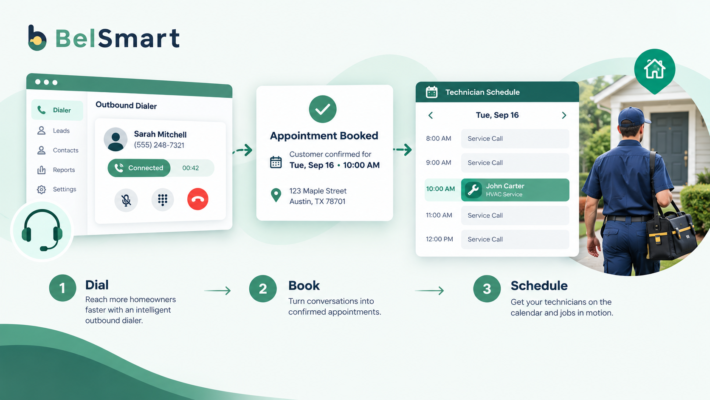
Outbound Dialer for Home Services: Fill More Appointments
An outbound dialer for home services is call center software that automates and speeds up outbound calling for HVAC, plumbing, roofing, and pest control companies, so a small team of callers can fill technician schedules without spending hours manually dialing numbers. For a business where revenue depends on a technician’s calendar being full every day, […]
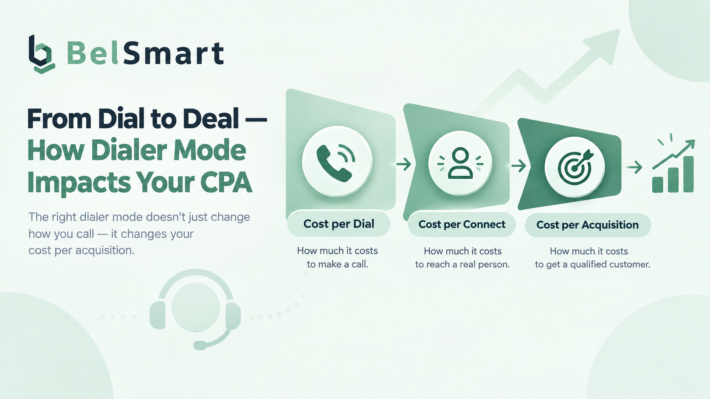
Cost Per Acquisition in Outbound Sales: The Dialer Effect
Cost per acquisition (CPA) in outbound sales is the total cost of dialing, staffing, and managing a campaign divided by the number of customers or qualified deals it produces. Dialer choice affects nearly every input in that equation — how many leads get answered, how much agent time goes to waste, and how many numbers […]
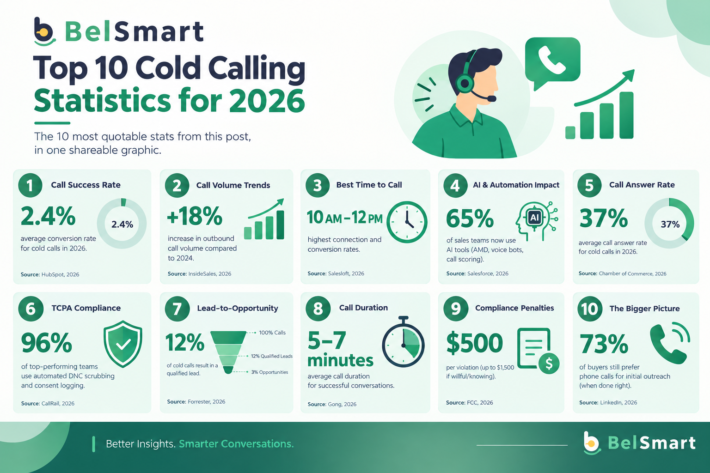
Top 10 Cold Calling Statistics 2026: 50+ Data Points & Sources
The average cold calling success rate in 2026 is 2.7%, up from 2.3% in 2025, according to Cognism’s analysis of over 200,000 calls conducted with WHAM. This guide compiles 50+ cold calling statistics for 2026, each tied to a named source and year, covering success rates, timing, AI adoption, and compliance data for B2B sales […]