Speed to Lead: Why Calling in 60 Seconds Triples Conversion
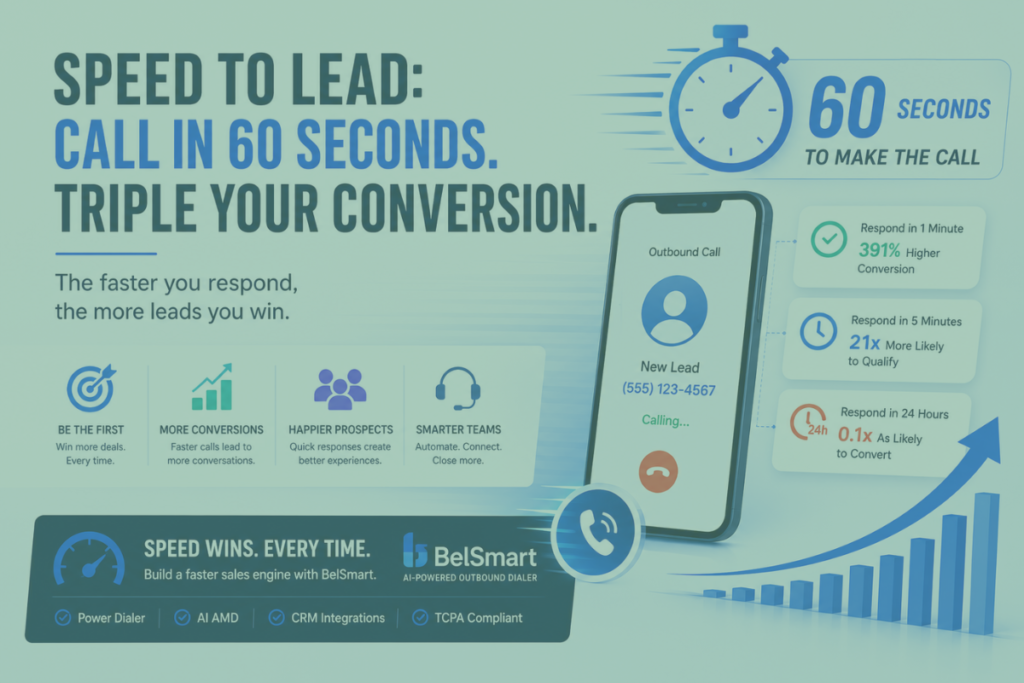
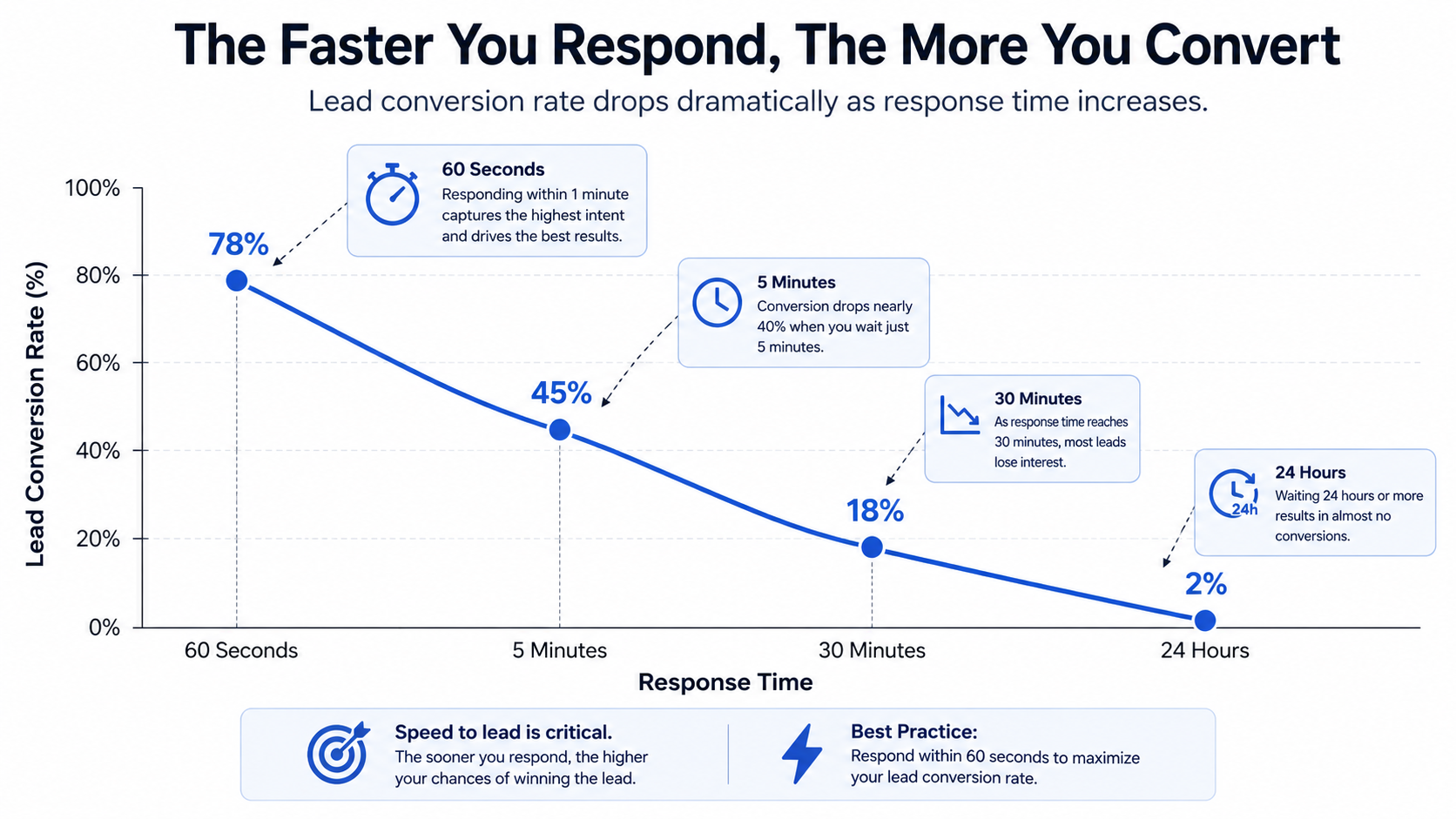
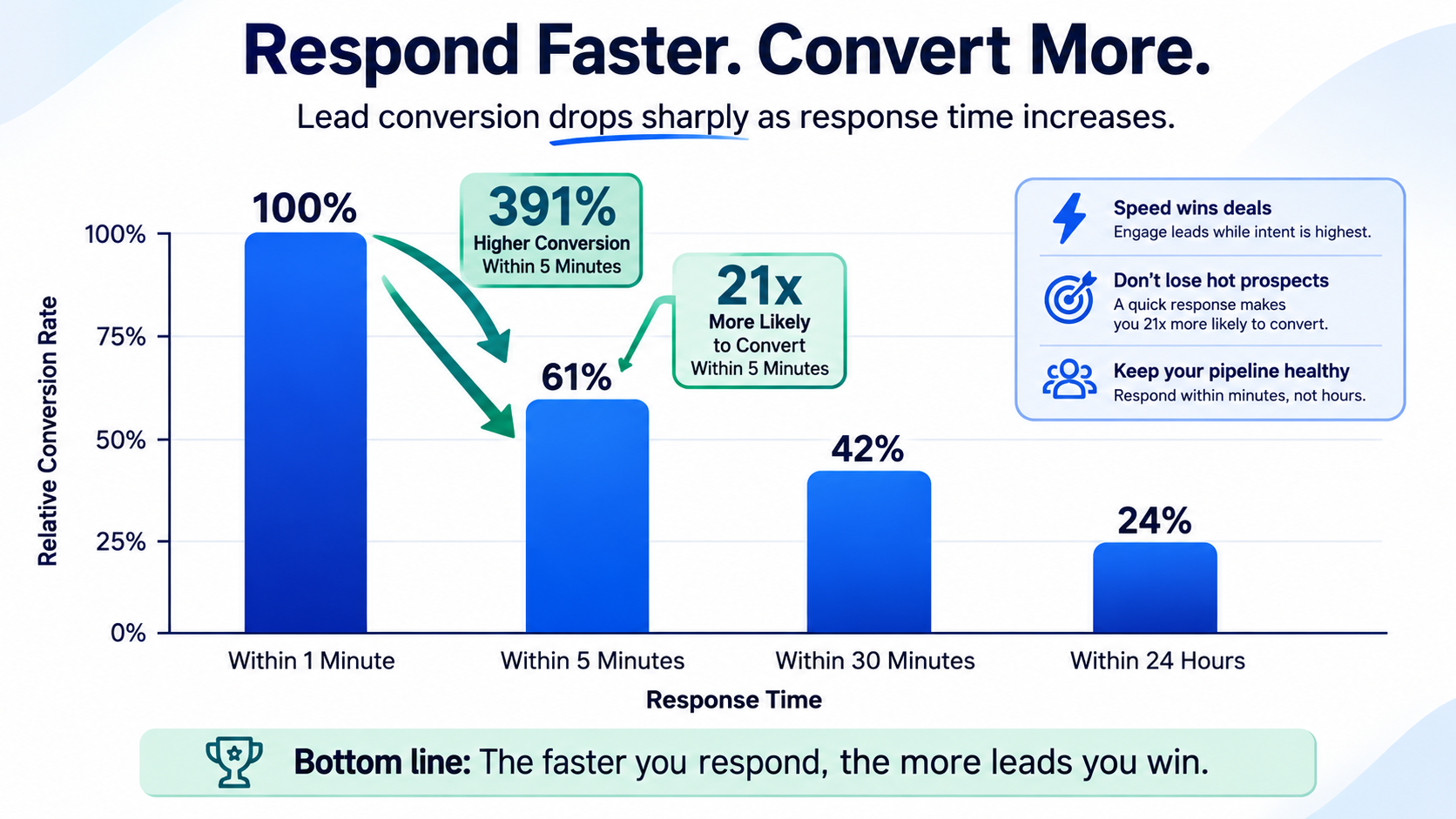
Speed to lead is the time between when a prospect submits an inquiry and when a sales rep makes first contact — and it is one of the most powerful, most under-leveraged levers in outbound sales. A study by Velocify analyzing millions of leads found that responding within one minute increases conversion rates by 391% compared to calling after two minutes, and a separate MIT/InsideSales Lead Response Management study found that responding within the first five minutes makes a lead 21 times more likely to qualify than waiting just 30 minutes. The pattern across nearly every major study on this topic is the same: conversion doesn’t decay gradually as response time increases — it falls off a cliff within the first few minutes, and the businesses that call first consistently win the deal, regardless of price or product quality.
This article breaks down exactly why the first 60 seconds matter this much, what the data actually shows, and how to build a calling operation that can realistically hit that window on every lead. For a broader case on why dialing infrastructure matters for lead generation specifically, see our guide on why every call center needs an outbound dialer for effective lead generation.
What “Speed to Lead” Actually Means
Speed to lead — sometimes called speed-to-contact or lead response time — measures the gap between a prospect’s inbound action (form fill, quote request, demo signup, missed call callback) and the moment a live person reaches out. It is a distinct metric from lead volume or lead quality, and it is measurable independently of everything else in a sales funnel: two identical leads, contacted at different speeds, produce measurably different outcomes.
Responding to a lead within 5 minutes increases conversion rates by up to 100x compared to a 30-minute delay, and research from the Lead Response Management Study and Harvard Business Review confirms that contacting leads within five minutes yields 21x higher qualification rates than waiting just 30 minutes. This isn’t a marginal optimization — it’s frequently the single largest controllable variable in a sales team’s conversion rate, larger than script quality, pricing, or even lead source.
Why the First 60 Seconds Specifically
The 60-second window matters because of a narrow, measurable psychological and competitive dynamic: a prospect who just submitted a form is at peak intent, peak attention, and — critically — often still comparing options in real time.
Key stat: InsideSales.com research found that 35–50% of all sales are won by the vendor that responds first, and 78% of customers buy from the first company that responds to their inquiry. If a prospect fills out three quote request forms within the same ten-minute window — extremely common in home services, insurance, real estate, and solar — the vendor who calls first has a structural advantage before the conversation even begins.
Conversion rates drop by 8 times when follow-up is delayed by a mere five minutes, and even waiting 10 minutes instead of five can slash the chances of qualifying a prospect by four times. The decay curve isn’t linear — it’s closer to exponential, which is exactly why a 60-second call converts so dramatically better than a 5-minute one, and why a 5-minute call converts so dramatically better than a 30-minute one.
Why Most Companies Never Get Close to This Window
The average B2B lead response time is 42 hours — nearly two days. Despite the well-documented payoff, many businesses still rely on manual workflows, and over 30% of leads are never contacted at all. Across tests of hundreds to thousands of companies, average response times run 29 to 42 hours, and between 24% and 63% never respond at all. Only 0.1% of businesses actually respond within the 5-minute window, while 57.1% don’t make their first contact attempt until more than a week later.
This gap between what the data says and what most companies actually do is the opportunity. If everyone else is slow, being fast is a competitive advantage that costs nothing but attention — and, in practice, the right dialing infrastructure to act on that attention instantly.
The root cause is almost always structural
- Leads sit in a queue or CRM view before a human ever sees them, especially outside business hours or during high-volume periods
- Manual dialing means a rep has to notice, look up, and dial — three separate steps between lead capture and first ring
- No automated routing exists to immediately surface a fresh lead to the next available agent
- Persistence gaps compound the speed problem — 50% of leads are never contacted a second time, and 81% of sellers stop at five or fewer attempts, even though seven or more yield about 15% more connections
The Data, Side by Side
| Response Window | Relative Outcome vs. Slower Response |
|---|---|
| Within 1 minute | 391% higher conversion than a 2-minute response |
| Within 5 minutes | 21x more likely to qualify than a 30-minute response |
| Within 5 minutes | 100x more likely to make contact than a 30-minute response |
| Within 1 hour | 7x more likely to qualify than waiting one more hour, 60x more likely than waiting 24 hours |
| First responder overall | 35–50% of all sales won by whichever vendor responds first |
The pattern holds across every study cited here, sourced from different research teams over different time periods: speed to lead isn’t a soft metric that “probably helps.” It’s one of the most consistently reproduced findings in sales research, and the effect size is large enough that most other optimization work a sales team does will never move conversion this much.
Where Speed to Lead Matters Most
Speed to lead has an outsized effect specifically in markets where a prospect can easily request quotes from multiple vendors at once — which is exactly the profile of home services, solar, insurance, real estate, and financial services lead generation. In these industries, a homeowner or shopper often submits the same request to two or three competing companies within minutes of each other, and the vendor who reaches them first typically gets the appointment regardless of who ultimately has the better offer. This dynamic is central to how Home Services outbound teams structure their entire lead-response operation around minimizing the gap between form submission and first ring.
How to Actually Hit the 60-Second Window at Scale
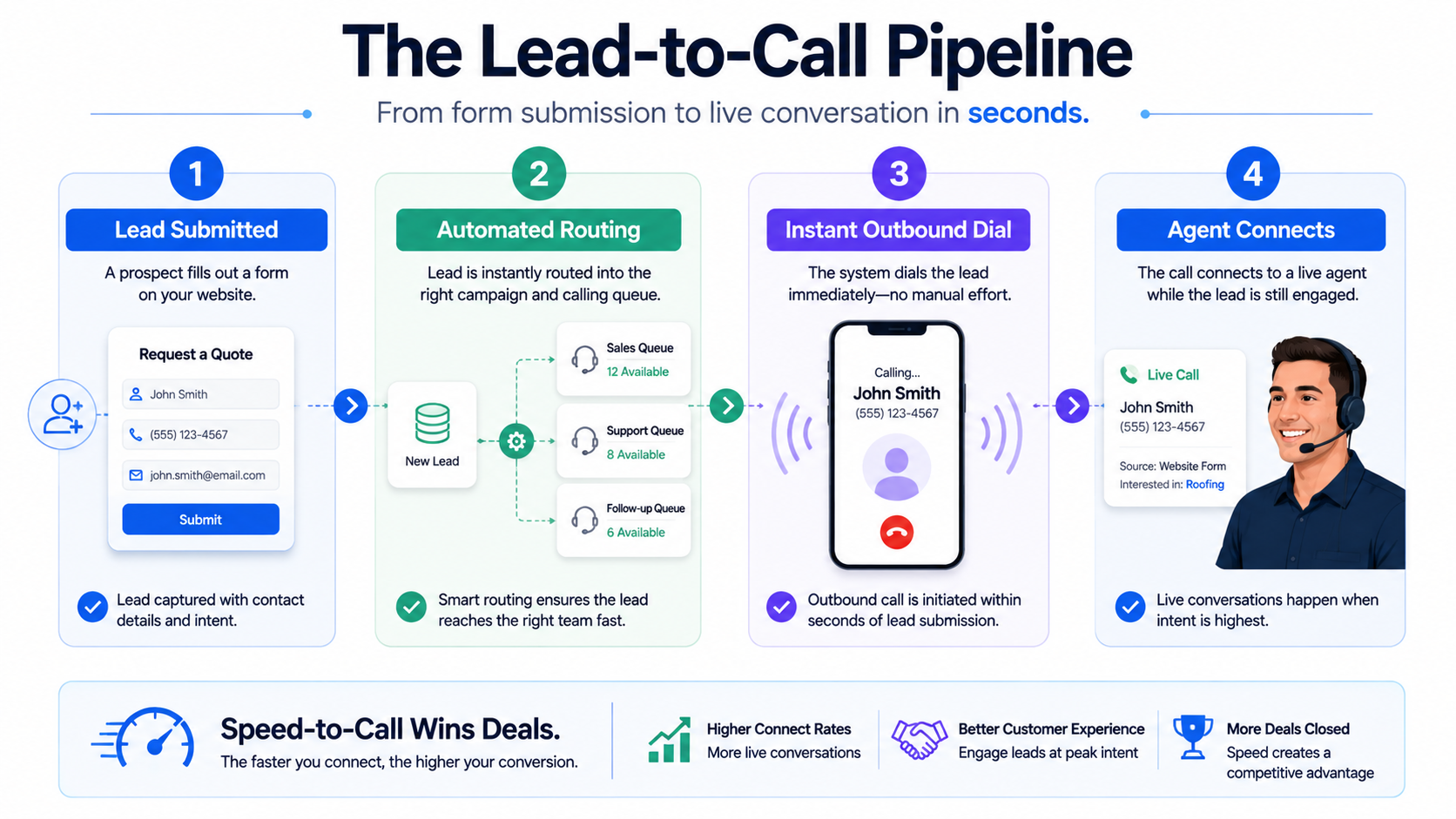
Knowing the data is easy. Building an operation that consistently acts on it is the harder part — and it depends on removing every manual step between lead capture and dial:
- Route new leads directly into a live calling queue, not a CRM inbox that a rep checks periodically
- Use automated dialing to initiate the call the instant a lead is routed, rather than relying on a rep to notice and manually dial
- Have the next available agent auto-connected, so speed doesn’t depend on which specific rep happens to be free
- Build in persistence, not just speed — since a large share of leads are never re-contacted at all, a single fast call isn’t a complete system on its own
- Track speed-to-lead as its own KPI, separate from overall conversion rate, so the team can see exactly where response time is slipping
This is precisely the operational gap that structured outbound dialer software is built to close — outbound dialer software that can route a freshly captured lead straight into a dialing queue and initiate the call automatically, rather than depending on a rep’s individual attentiveness.
Speed and Structure Have to Work Together
Speed alone isn’t the whole system — it has to be paired with structured lead management so fast calls are also being logged, tracked, and followed up on consistently. A fast first call that isn’t logged, isn’t followed up on, or gets lost the moment the rep moves to the next lead defeats the purpose of calling quickly in the first place. See how automated lead routing and follow-up cadence work together on our Lead Management page.
For the calling mechanics specifically, a power dialer is well suited to speed-to-lead operations because it automatically advances to the next call the moment an agent is free — which matters just as much for the second and third call attempt on a lead as it does for the first, given how much persistence affects overall contact rates.
Bottom line: the businesses winning on speed to lead aren’t relying on reps to be fast — they’ve removed the steps where speed could be lost in the first place.
Frequently Asked Questions
How much does calling a lead within 60 seconds actually improve conversion?
Multiple large-scale studies converge on the same order of magnitude: calling within one minute increases conversion by up to 391% compared to a two-minute response, and responding within five minutes makes a lead up to 21 times more likely to qualify compared to a 30-minute delay.
What is considered a good speed-to-lead benchmark for sales teams?
Best-in-class teams aim for under 60 seconds to a few minutes, while the industry average B2B response time is around 42 hours — meaning even hitting a 1-hour response window puts a team well ahead of most competitors.
Why does response speed matter so much when other vendors are involved?
Because 35–50% of all sales are won by whichever vendor responds first, and 78% of customers buy from the first company that reaches them — in markets where prospects request quotes from multiple vendors, first contact often decides the deal before any pitch happens.
Is speed to lead more important than lead quality or follow-up persistence?
Speed and persistence work together rather than in competition — a fast first call still needs consistent follow-up, since roughly half of leads are never contacted a second time even though additional attempts meaningfully increase connection rates.
What’s the biggest reason most companies fail to hit fast response times?
The bottleneck is almost always structural rather than a lack of urgency — leads sitting in a queue before a human sees them, manual dialing steps, and no automated routing to the next available agent, all of which automated dialing infrastructure is specifically designed to remove.
Build a lead response system that actually hits 60 seconds.
Book a Personalized Demo See Plans & Pricing