
Outbound Dialer Glossary: 30 Terms Every Sales Team Should Know in 2026
What is an outbound dialer glossary?
An outbound dialer glossary is a reference guide that defines the technical, compliance, and performance terms used across outbound calling software — from dialing modes like power and parallel dialers to compliance terms like TCPA and abandoned call rate. Sales managers, SDR leads, and call center operators use this vocabulary to evaluate dialer platforms, configure campaigns correctly, and stay compliant with US calling regulations.
Key Terms Covered in This Glossary
- 6 dialing mode terms — including manual, preview, power, parallel, and predictive dialers
- 7 compliance and legal terms — including TCPA, DNC, abandoned call rate, and the FCC one-to-one consent rule
- 5 call handling terms — including AI AMD, voicemail drop, and local presence dialing
- 5 performance metric terms — including connect rate, talk time, and dial rate
- 4 CRM and technology terms — including two-way sync, REST API, and webhooks
- 3 team and campaign management terms — including lead recycling and campaign pacing
Outbound dialer software comes with its own vocabulary, and that vocabulary is not optional to learn. A sales manager evaluating vendors who doesn’t know the difference between a power dialer and a predictive dialer risks buying the wrong tool for the wrong campaign. An SDR lead who can’t define “abandoned call rate” risks running a campaign that violates federal law without realizing it until a fine arrives.
This glossary defines 30 terms every sales team should know before choosing, configuring, or running a campaign on outbound dialer software in 2026 — organized into six categories so you can jump straight to what you need or read start to finish for a complete working vocabulary.
1. Dialing Modes & Systems
These six terms describe the core calling mechanisms outbound dialer software uses to place calls. Understanding the difference between them is the single most important decision point when choosing a platform.
Outbound Dialer
What it is: Software that automatically or semi-automatically places phone calls from a contact list on behalf of a sales agent or call center team, eliminating manual dialing and connecting agents only to live answered calls.
Outbound dialer is the umbrella term covering every dialing mode below. For a full breakdown of how outbound dialer software works, see the Ultimate Guide to Outbound Dialer Software.
Manual Dialer
What it is: A dialer that requires the agent to initiate every call by clicking a button next to a contact record, with no auto-dialing of any kind.
Manual dialers carry the lowest TCPA risk because a live agent is always present before a number is dialed. They’re used when call quality and compliance matter more than volume — common in B2B sales, healthcare, and financial services.
Preview Dialer
What it is: A dialer that shows the agent a contact’s full CRM profile — name, company, notes, history — before the call is placed, with a configurable preview window.
Preview dialers are common in insurance and financial services, where personalized context materially changes conversion rates on the first sentence of a call.
Power Dialer
What it is: A dialer that automatically dials the next contact the moment an agent finishes their previous call, using a 1:1 ratio that guarantees an agent is available on every connection.
Power dialers deliver 80–150 daily dials per agent, compared to 40–80 with manual dialing, while eliminating abandoned call risk entirely.
Parallel Dialer
What it is: A dialer that calls multiple phone numbers simultaneously for a single agent — typically two to ten lines at once — connecting the agent only when a live person answers.
Parallel dialers produce three to five times more live connections per hour than single-line dialing. See the Power Dialer vs Parallel Dialer comparison for exactly when to use each mode.
Predictive Dialer
What it is: A dialer that uses statistical algorithms to dial multiple numbers per agent based on predicted answer rates and agent availability, often dialing ahead of actual agent capacity.
Predictive dialers generate the highest raw call volume of any mode, but that same algorithmic over-dialing is what creates the compliance exposure regulators scrutinize most closely.
2. Compliance & Legal
These seven terms cover the regulatory vocabulary every US outbound sales team needs — because getting this wrong carries fines, not just lost productivity.
TCPA (Telephone Consumer Protection Act)
What it is: The US federal law governing outbound calling, including consent requirements, do-not-call obligations, and abandoned call limits. Violations carry fines of $500 to $1,500 per call.
DNC (Do Not Call) List
What it is: A national or state-level registry of phone numbers that have opted out of receiving sales calls. Outbound dialer software must scrub campaign lists against DNC registries before any dial is placed.
Abandoned Call Rate
What it is: The percentage of answered calls where no live agent connects within two seconds — a metric the FCC caps at 3% per 30-day rolling period for any outbound campaign.
Parallel and predictive dialers carry the highest abandoned call risk because they intentionally dial more lines than there are available agents.
Consent Logging
What it is: The practice of documenting and storing specific, retrievable consent records for each contact before placing automated outbound calls to them.
FCC One-to-One Consent Rule
What it is: A rule effective January 2024 requiring businesses to obtain individual, specific written consent from each consumer — a single blanket consent no longer covers multiple companies or campaign types.
For the full compliance breakdown, see the TCPA Compliance for Outbound Sales Teams guide.
GDPR (General Data Protection Regulation)
What it is: The European Union’s data protection law, relevant to any outbound campaign that contacts EU residents — covering consent, storage, and the right to be forgotten for call recordings and contact records.
STIR/SHAKEN
What it is: A telecom industry framework that authenticates caller ID information to combat spoofing and reduce the “Spam Likely” labels that suppress answer rates on legitimate outbound calls.
3. Call Handling & Detection
These five terms describe what happens in the seconds after a call connects — the mechanics that determine whether a dial becomes a live conversation or a wasted attempt.
AI AMD (Answering Machine Detection)
What it is: A real-time audio analysis system that determines whether an answered call has connected to a live human or a voicemail recording, typically within one to three seconds.
Belsmart’s AI AMD makes this determination in under two seconds — see AI Answering Machine Detection: How It Works for the full technical breakdown.
Voicemail Drop
What it is: A pre-recorded message left automatically when AMD detects a voicemail, without the agent waiting through the greeting — saving 30–60 seconds per voicemail.
Call Disposition
What it is: A category an agent assigns to a completed call — such as “connected,” “no answer,” “callback requested,” or “not interested” — that syncs to the CRM and drives lead recycling logic.
Local Presence Dialing
What it is: A feature that automatically displays a phone number with a local area code matching each prospect’s location, increasing answer rates by 30–40% compared to out-of-state or toll-free numbers.
Caller ID Spam Remediation
What it is: Tools and monitoring that prevent outbound numbers from being flagged as “Spam Likely” by carriers — including number reputation monitoring, call volume pacing per number, and STIR/SHAKEN attestation.
4. Performance Metrics
These five terms are the numbers sales managers track daily to judge whether a campaign — or a platform — is actually working.
Connect Rate
What it is: The percentage of dialed calls that result in a live conversation with a prospect, as opposed to a voicemail, busy signal, or no answer.
Talk Time
What it is: The percentage of an agent’s working day spent in live conversation. Manual dialing typically produces 20–27% talk time; outbound dialer software raises this to 40–60%.
Dial Rate
What it is: The number of outbound call attempts placed per agent per hour or per shift — a raw volume metric distinct from connect rate or talk time.
Conversion Rate
What it is: The percentage of live connected calls that result in a desired outcome — a booked meeting, a closed sale, or a qualified lead — depending on the campaign’s goal.
Idle Time
What it is: The time an agent spends between calls with no active dial or conversation — the metric outbound dialer software is fundamentally designed to eliminate.
5. CRM & Technology
These four terms cover how outbound dialer software connects to the rest of a sales team’s tech stack.
CRM Integration
What it is: A connection between the dialer and a customer relationship management platform that syncs call outcomes, recordings, and notes automatically to the contact record.
Belsmart integrates natively with HubSpot, Salesforce, Zoho CRM, Pipedrive, Freshsales, LeadSquared, and Bitrix24 — see CRM Integration with Outbound Dialer Software for the full breakdown.
Two-Way Sync
What it is: Integration where the dialer pushes call data to the CRM and the CRM pushes updated lead data back to the dialer in real time — as opposed to one-way sync, which only flows in a single direction.
REST API
What it is: A standardized way for outbound dialer software to connect to custom or non-standard systems that don’t have a native integration.
Webhook
What it is: An automated message sent from the dialer to another system the moment a specific event occurs — such as a completed call or a new disposition — enabling real-time automation without manual exports.
6. Team & Campaign Management
These three terms describe how supervisors configure and monitor outbound campaigns day to day.
Smart Lead Recycling
What it is: A system that automatically re-queues unanswered contacts based on configurable rules — time of day, retry interval, attempt count, and prior disposition — so no viable lead is lost to poor timing.
Campaign Pacing
What it is: The configured ratio of calls dialed to agents available, which determines both call volume and abandoned call rate exposure — a core setting on any power, parallel, or predictive dialer campaign.
Barge, Whisper & Listen Modes
What it is: Three live call-coaching tools on supervisor dashboards. Barge lets a supervisor join a live call; whisper lets a supervisor speak only to the agent; listen enables silent quality monitoring — all without disrupting the live call.
Quick Reference Table
All 30 terms, organized by category, in one scannable view.
| Category | Terms Covered |
|---|---|
| Dialing Modes & Systems | Outbound Dialer, Manual Dialer, Preview Dialer, Power Dialer, Parallel Dialer, Predictive Dialer |
| Compliance & Legal | TCPA, DNC List, Abandoned Call Rate, Consent Logging, One-to-One Consent Rule, GDPR, STIR/SHAKEN |
| Call Handling & Detection | AI AMD, Voicemail Drop, Call Disposition, Local Presence Dialing, Caller ID Spam Remediation |
| Performance Metrics | Connect Rate, Talk Time, Dial Rate, Conversion Rate, Idle Time |
| CRM & Technology | CRM Integration, Two-Way Sync, REST API, Webhook |
| Team & Campaign Management | Smart Lead Recycling, Campaign Pacing, Barge/Whisper/Listen Modes |
Frequently Asked Questions
A power dialer dials one number per agent at a time in a 1:1 ratio, guaranteeing an agent is available on every connection and eliminating abandoned call risk. A predictive dialer uses algorithms to dial ahead of agent availability based on predicted answer rates, generating higher call volume but carrying greater abandoned call compliance risk.
Abandoned call rate is the percentage of answered calls where no live agent connects within two seconds. The FCC caps this at 3% per 30-day rolling period, and outbound dialer software must enforce this limit automatically through pacing controls.
AI AMD is a real-time audio analysis feature that determines whether an answered call has connected to a live human or a voicemail, typically within one to three seconds, so the system can route live answers to agents and drop or leave a recording on voicemails automatically.
Local presence dialing displays a phone number with a local area code matching each prospect’s location. It increases outbound answer rates by 30–40% compared to calling from an out-of-state or toll-free number, since prospects are more likely to answer a familiar-looking number.

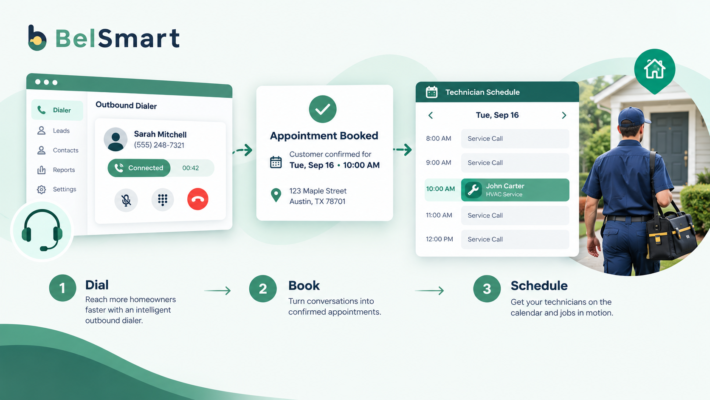
Outbound Dialer for Home Services: Fill More Appointments
An outbound dialer for home services is call center software that automates and speeds up outbound calling for HVAC, plumbing, roofing, and pest control companies, so a small team of callers can fill technician schedules without spending hours manually dialing numbers. For a business where revenue depends on a technician’s calendar being full every day, […]
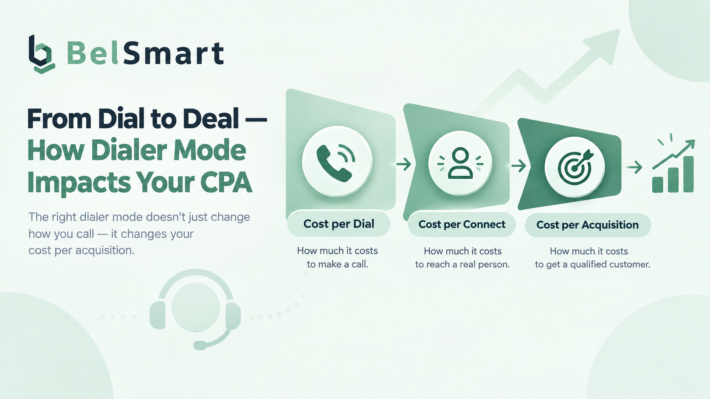
Cost Per Acquisition in Outbound Sales: The Dialer Effect
Cost per acquisition (CPA) in outbound sales is the total cost of dialing, staffing, and managing a campaign divided by the number of customers or qualified deals it produces. Dialer choice affects nearly every input in that equation — how many leads get answered, how much agent time goes to waste, and how many numbers […]
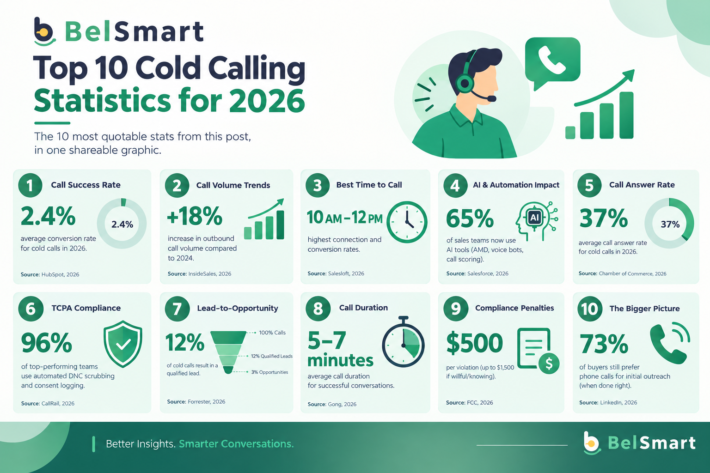
Top 10 Cold Calling Statistics 2026: 50+ Data Points & Sources
The average cold calling success rate in 2026 is 2.7%, up from 2.3% in 2025, according to Cognism’s analysis of over 200,000 calls conducted with WHAM. This guide compiles 50+ cold calling statistics for 2026, each tied to a named source and year, covering success rates, timing, AI adoption, and compliance data for B2B sales […]